708 posters, 8 topics, 16 sessions, 1,190 authors, 600 institutions
ePostersLive by SciGen Technologies S.A. All rights reserved.
ISQua's 39th International Conference 2023
August 27 - 30, 2023 | Seoul, Republic of Korea

P169
KOREAN STAFF NURSES’ MEDICATION INTERRUPTION, MEDICATION ERRORS, AND BURNOUT: THE MEDIATING EFFECTS OF NURSE-PERCEIVED TIME PRESSURE
Poster Presenter
Part of Topic
Patient Safety & Quality Improvement
Korea staff nurses’ medication interruption, medication errors and burnout: The mediating effects of nurse-perceived time pressure
INTRODUCTION
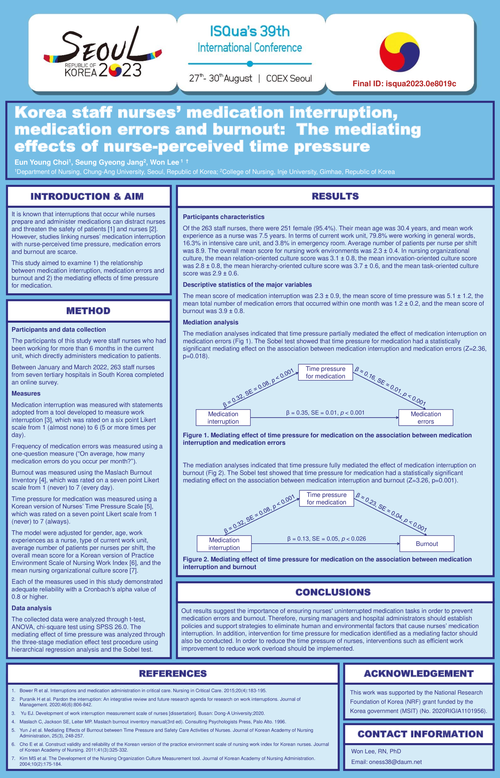
It is known that interruptions that occur while nurses prepare and administer medications can distract nurses and threaten the safety of patients [1] and nurses [2]. However, studies linking nurses’ medication interruption with nurse-perceived time pressure, medication errors and burnout are scarce. This study aimed to examine 1) the relationship between medication interruption, medication errors and burnout and 2) the mediating effects of time pressure for medication.
METHOD
Participants and data collection
The participants of this study were staff nurses who had been working for more than 6 months in the current unit, which directly administers medication to patients. Between January and March 2022, 263 staff nurses from seven tertiary hospitals in South Korea completed an online survey.
Measures
Medication interruption was measured with statements adopted from a tool developed to measure work interruption [3], which was rated on a six point Likert scale from 1 (almost none) to 6 (5 or more times per day). Frequency of medication errors was measured using a one-question measure (“On average, how many medication errors do you occur per month?”). Burnout was measured using the Maslach Burnout Inventory [4], which was rated on a seven point Likert scale from 1 (never) to 7 (every day). Time pressure for medication was measured using a Korean version of Nurses’ Time Pressure Scale [5], which was rated on a seven point Likert scale from 1 (never) to 7 (always). The model were adjusted for gender, age, work experiences as a nurse, type of current work unit, average number of patients per nurses per shift, the overall mean score for a Korean version of Practice Environment Scale of Nursing Work Index [6], and the mean nursing organizational culture score [7]. Each of the measures used in this study demonstrated adequate reliability with a Cronbach’s alpha value of 0.8 or higher.
Data analysis
The collected data were analyzed through t-test, ANOVA, chi-square test using SPSS 26.0. The mediating effect of time pressure was analyzed through the three-stage mediation effect test procedure using hierarchical regression analysis and the Sobel test.
RESULTS
Participants characteristics
Of the 263 staff nurses, there were 251 female (95.4%). Their mean age was 30.4 years, and mean work experience as a nurse was 7.5 years. In terms of current work unit, 79.8% were working in general words, 16.3% in intensive care unit, and 3.8% in emergency room. Average number of patients per nurse per shift was 8.9. The overall mean score for nursing work environments was 2.3 ± 0.4. In nursing organizational culture, the mean relation-oriented culture score was 3.1 ± 0.8, the mean innovation-oriented culture score was 2.8 ± 0.8, the mean hierarchy-oriented culture score was 3.7 ± 0.6, and the mean task-oriented culture score was 2.9 ± 0.6.
Descriptive statistics of the major variables
The mean score of medication interruption was 2.3 ± 0.9, the mean score of time pressure was 5.1 ± 1.2, the mean total number of medication errors that occurred within one month was 1.2 ± 0.2, and the mean score of burnout was 3.9 ± 0.8.
Mediation analysis
The mediation analyses indicated that time pressure partially mediated the effect of medication interruption on medication errors (Fig 1). The Sobel test showed that time pressure for medication had a statistically significant mediating effect on the association between medication interruption and medication errors (Z=2.36, p=0.018).
Figure 1. Mediating effect of time pressure for medication on the association between medication interruption and medication errors
The mediation analyses indicated that time pressure fully mediated the effect of medication interruption on burnout (Fig 2). The Sobel test showed that time pressure for medication had a statistically significant mediating effect on the association between medication interruption and burnout (Z=3.26, p=0.001).
Figure 2. Mediating effect of time pressure for medication on the association between medication interruption and burnout
CONCLUSIONS
Out results suggest the importance of ensuring nurses' uninterrupted medication tasks in order to prevent medication errors and burnout. Therefore, nursing managers and hospital administrators should establish policies and support strategies to eliminate human and environmental factors that cause nurses’ medication interruption. In addition, intervention for time pressure for medication identified as a mediating factor should also be conducted. In order to reduce the time pressure of nurses, interventions such as efficient work improvement to reduce work overload should be implemented.