708 posters, 8 topics, 16 sessions, 1,190 authors, 600 institutions
ePostersLive by SciGen Technologies S.A. All rights reserved.
ISQua's 39th International Conference 2023
August 27 - 30, 2023 | Seoul, Republic of Korea

P167
INTRODUCING THE APPLIED THEATRE APPROACH TO PATIENT SAFETY EDUCATION IN JAPANESE HOSPITALS
Poster Presenter
Authors
Affiliations
Part of Topic
Patient Safety & Quality Improvement
INTRODUCING THE APPLIED THEATRE APPROACH TO PATIENT SAFETY EDUCATION IN JAPANESE HOSPITALS
E. Nakagami-Yamaguchi1, H. Murao2, Y. Hasegawa1, M. Nitta3, and E. Ueda3
1 Osaka Metropolitan University Hospital, Osaka, Japan
2 Osaka Medical and Pharmaceutical University Mishima-minami Hospital, Takatsuki, Japan
3 Osaka Medical and Pharmaceutical University Hospital, Takatsuki, Japan
INTRODUCTION
The Japanese government mandates that all hospital staff receive patient safety education at least twice per year. Furthermore, the government also states that the educational content should be interactive rather than simply lectures. To this end, we introduced applied theater (AT) for patient safety education. AT is an appropriate way to learn about patient safety topics, such as teamwork, leadership, communication, etc. AT-based training programs (AT-BTP) consist of a variety of exercises, such as short games and scripted or improvised roleplay.
AIM
In this study, we developed AT-BTP for patient safety (PS) education and reported the results for two hospital cases. We then examined the learning outcomes and discussed the impact of AT-BTP on staff self-efficacy.
METHOD
Project1 (P1): Departmental safety officers, executives, and departmental managers at Hospital A participated in a 60-minute program with a leadership theme and included conversational training.
Project2 (P2): Departmental safety officers at Hospital B participated 3 h 30 min program with the theme of teamwork and communication.
The questionnaires were administered at the end of the program. Text data on participants' opinions in the free description area were grouped into categories. In P2, the Japanese General Self-Efficacy Scale (GSES) was administered immediately before and after the exercises. The data was statistically analyzed using the Wilcoxon signed-rank test.
RESULTS
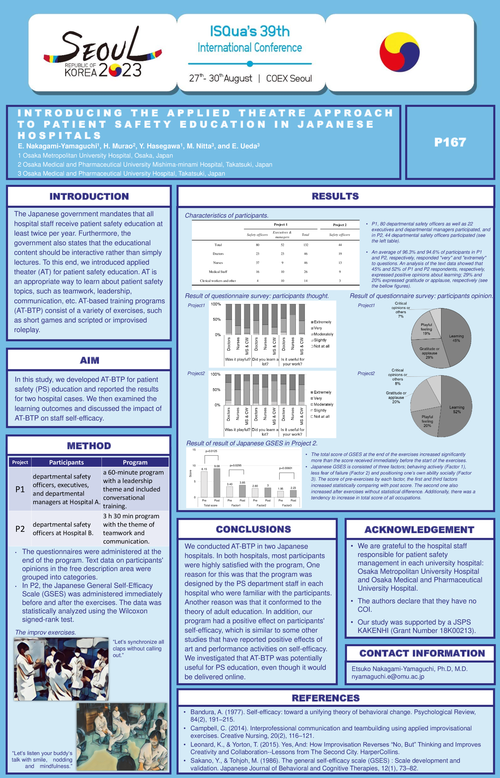
An average of 96.3% and 94.6% of participants in P1 and P2, respectively, responded "very" and "extremely" to questions. An analysis of the text data showed that 45% and 52% of P1 and P2 respondents, respectively, expressed positive opinions about learning; 29% and 20% expressed gratitude or applause, respectively (see the bellow figures).
The total score of GSES at the end of the exercises increased significantly more than the score received immediately before the start of the exercises.
Japanese GSES is consisted of three factors; behaving actively (Factor 1), less fear of failure (Factor 2) and positioning one’s own ability socially (Factor 3). The score of pre-exercises by each factor, the first and third factors increased statistically comparing with post score. The second one also increased after exercises without statistical difference. Additionally, there was a tendency to increase in total score of all occupations.
CONCLUSION
We conducted AT-BTP in two Japanese hospitals. In both hospitals, most participants were highly satisfied with the program, One reason for this was that the program was designed by the PS department staff in each hospital who were familiar with the participants. Another reason was that it conformed to the theory of adult education. In addition, our program had a positive effect on participants' self-efficacy, which is similar to some other studies that have reported positive effects of art and performance activities on self-efficacy. We investigated that AT-BTP was potentially useful for PS education, even though it would be delivered online.