708 posters, 8 topics, 16 sessions, 1,190 authors, 600 institutions
ePostersLive by SciGen Technologies S.A. All rights reserved.
ISQua's 39th International Conference 2023
August 27 - 30, 2023 | Seoul, Republic of Korea

P158
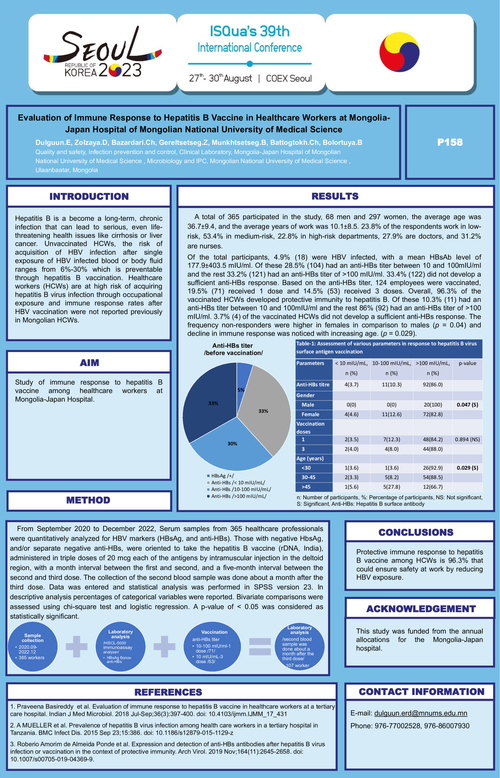
EVALUATION OF IMMUNE RESPONSE TO HEPATITIS B VACCINE IN HEALTHCARE WORKERS AT MONGOLIA-JAPAN HOSPITAL OF MONGOLIAN NATIONAL UNIVERSITY OF MEDICAL SCIENCE
Poster Presenter
Part of Topic
Patient Safety & Quality Improvement
ISQUA2023-ABS-3072
EVALUATION OF IMMUNE RESPONSE TO HEPATITIS B VACCINE IN HEALTHCARE WORKERS AT MONGOLIA-
JAPAN HOSPITAL OF MONGOLIAN NATIONAL UNIVERSITY OF MEDICAL SCIENCE
Dulguun Erdenebat*,Zolzaya Deleg, Bazardari Chuluunbaatar, Gereltsetseg Zulmunkh,Battogtokh Chimeddorj, Munkhtsetseg Batjargal, Bolortuya batbileg
1Quality and safety, 2infection prevention and control, 3Clinical Laboratory, Mongolia-Japan Hospital of Mongolian National University of Medical Science , 4Microbiology and IPC, Mongolian National University of Medical Science ,ulaanbaatar, Mongolia
Introduction: Hepatitis B is a become a long-term, chronic infection that can lead to serious, even life-threatening health
issues like cirrhosis or liver cancer. Unvaccinated HCWs, the risk of acquisition of HBV infection after single exposure of
HBV infected blood or body fluid ranges from 6%-30% which is preventable through hepatitis B vaccination. Healthcare
workers (HCWs) are at high risk of acquiring hepatitis B virus infection through occupational exposure and immune
response rates after HBV vaccination were not reported previously in Mongolian HCWs.
Methods: From September 2020 to December 2022, Serum samples from 365 healthcare professionals were
quantitatively analyzed for HBV markers (HBsAg, and anti-HBs). Chemiluminescence immunoassay were conducted
using an automated HISCL-5000 immunoassay analyzer. Those with negative HbsAg, and/or separate negative anti-
HBs, were oriented to take the hepatitis B vaccine (rDNA, India), administered in triple doses of 20 mcg each of the
antigens by intramuscular injection in the deltoid region, with a month interval between the first and second, and a five-
month interval between the second and third dose. The collection of the second blood sample was done about a month
after the third dose. Data was entered and statistical analysis was performed in SPSS version 23. In descriptive analysis
percentages of categorical variables were reported. Bivariate comparisons were assessed using chi-square test and
logistic regression. A p-value of < 0.05 was considered as statistically significant.
Results: A total of 365 participated in the study, 68 men and 297 women, the average age was 36.7±9.4, and the
average years of work was 10.1±8.5. 23.8% of the respondents work in low-risk, 53.4% in medium-risk, 22.8% in high-
risk departments, 27.9% are doctors, and 31.2% are nurses.
Of the total participants, 4.9% (18) were HBV infected, with a mean HBsAb level of 177.9±403.5 mIU/ml. Of these 28.5%
(104) had an anti-HBs titer between 10 and 100mIU/ml and the rest 33.2% (121) had an anti-HBs titer of >100 mIU/ml.
33.4% (122) did not develop a sufficient anti-HBs response. Based on the anti-HBs titer, 124 employees were vaccinated,
19.5% (71) received 1 dose and 14.5% (53) received 3 doses. Overall, 96.3% of the vaccinated HCWs developed
protective immunity to hepatitis B. Of these 10.3% (11) had an anti-HBs titer between 10 and 100mIU/ml and the rest
86% (92) had an anti-HBs titer of >100 mIU/ml. 3.7% (4) of the vaccinated HCWs did not develop a sufficient anti-HBs
response. The frequency non-responders were higher in females in comparison to males (p = 0.04) and decline in
immune response was noticed with increasing age. (p = 0.029).
Conclusion: Protective immune response to hepatitis B vaccine among HCWs is 96.3% that could ensure safety at work
by reducing HBV exposure.