708 posters, 8 topics, 16 sessions, 1,190 authors, 600 institutions
ePostersLive by SciGen Technologies S.A. All rights reserved.
ISQua's 39th International Conference 2023
August 27 - 30, 2023 | Seoul, Republic of Korea

P135
THE IMPACT OF QUALITY IMPROVEMENT PROGRAM ON PATIENTS WITH UNPLANNED EXTUBATION
Poster Presenter
Authors
Affiliations
Part of Topic
Patient Safety & Quality Improvement
The impact of Quality Improvement program on Patients with Unplanned Extubation
Chin-Ming Chen1,2
1Department of Intensive Care Medicine, 2Center for Quality Improvement, Chi Mei Medical Center, Tainan, Taiwan
Introduction: The application of effective strategy may improve the quality of patient with mechanical ventilator (MV) and prevent the further morbidity and mortality of patients experienced unplanned extubation (UE) in intensive care unit (ICU). A continuous quality improvement (CQI) concept had been promoted in reducing the incidence of UE since 2001 in a medical center in Southern Taiwan. Furthermore, we started to use big data and artificial intelligence (AI)/machine learning technologies to establish new predictive models of the optimal timing to MV weaning since 2020.
Methods
The CQI concept had initiated since year 2001 and was promoted in all 6 ICUs (96 beds) in Chi-Mei Medical center in southern Taiwan. The CQI concept, focusing on serial intervention tools including standardization of procedures, improvement of communication, revision of sedation and weaning protocols, changing strategy for physical restriction, establishment of task force for identification and management of high-risk patients, implementation of quality improvement models including Breakthrough Series (BTS) and Team Resource Management (TRM), was launched to reduce the incidence of UE in MV patients. The performance of AI in 2020 also helped clinicians to shorten the MV duration
Result
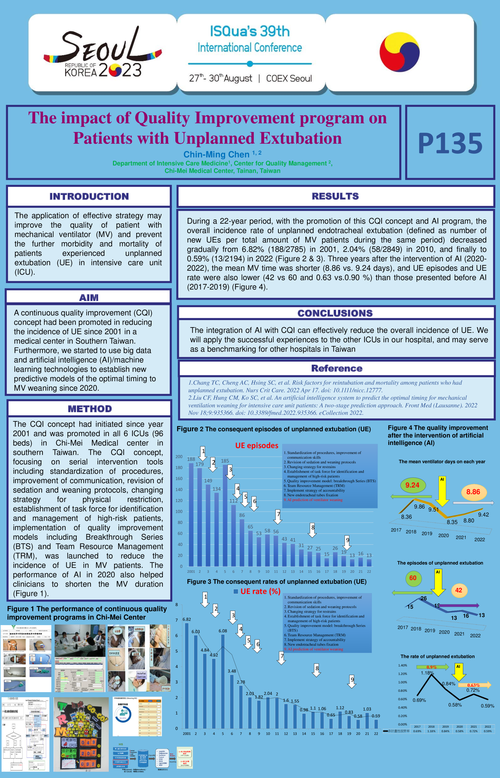
During a 22-year period, with the promotion of this CQI concept and AI program, the overall incidence rate of UE (defined as number of new UEs per total amount of MV patients during the same period) decreased gradually from 6.82% (188/2785) in 2001, 2.04% (58/2849) in 2010, and finally to 0.59% (13/2194) in 2022. Three years after the intervention of AI (2020-2022), the mean MV time was shorter (8.86 vs. 9.24 days), and UE episodes and UE rate were also lower (42 vs 60 and 0.63 vs.0.90 %) than those presented before AI (2017-2019)
Conclusions: The integration of AI with CQI can effectively reduce the overall incidence of UE. We will apply the successful experiences to the other ICUs in our hospital, and may serve as a benchmarking for other hospitals in Taiwan.
Keywords: unplanned extubation, ventilator, quality improvement, artificial intelligence
References:
- Chang TC, Cheng AC, Hsing SC, et al. Risk factors for reintubation and mortality among patients who had unplanned extubation. Nurs Crit Care. 2022 Apr 17. doi: 10.1111/nicc.12777.
- Liu CF, Hung CM, Ko SC, et al. An artificial intelligence system to predict the optimal timing for mechanical ventilation weaning for intensive care unit patients: A two-stage prediction approach. Front Med (Lausanne). 2022 Nov 18;9:935366. doi: 10.3389/fmed.2022.935366. eCollection 2022.