708 posters, 8 topics, 16 sessions, 1,190 authors, 600 institutions
ePostersLive by SciGen Technologies S.A. All rights reserved.
ISQua's 39th International Conference 2023
August 27 - 30, 2023 | Seoul, Republic of Korea

P125
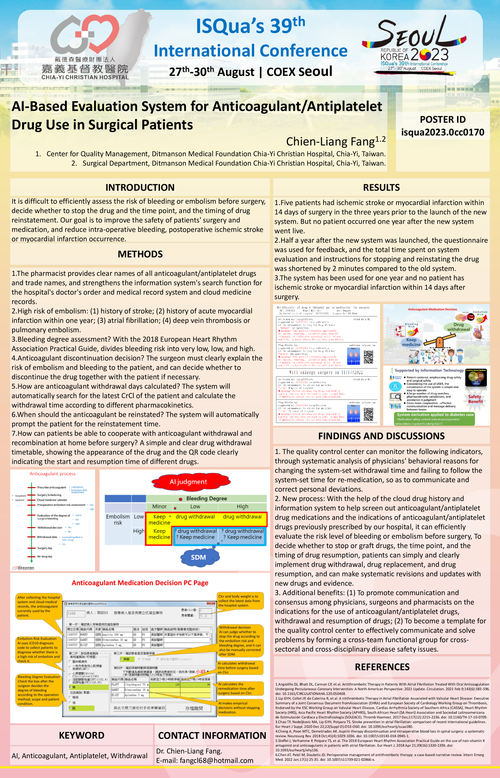
AI-BASED EVALUATION SYSTEM FOR ANTICOAGULANT/ANTIPLATELET DRUG USE IN SURGICAL PATIENTS
Poster Presenter
Part of Topic
Patient Safety & Quality Improvement
INTRODUCTION
It is difficult to efficiently assess the risk of bleeding or embolism before surgery, decide whether to stop the drug and the time point, and the timing of drug reinstatement. Our goal is to improve the safety of patients' surgery and medication, and reduce intra-operative bleeding, postoperative ischemic stroke or myocardial infarction occurrence.
METHODS
1.The pharmacist provides clear names of all anticoagulant/antiplatelet drugs and trade names, and strengthens the information system's search function for the hospital's doctor's order and medical record system and cloud medicine records.
2.High risk of embolism: (1) history of stroke; (2) history of acute myocardial infarction within one year; (3) atrial fibrillation; (4) deep vein thrombosis or pulmonary embolism.
3.Bleeding degree assessment? With the 2018 European Heart Rhythm Association Practical Guide, divides bleeding risk into very low, low, and high.
4.Anticoagulant discontinuation decision? The surgeon must clearly explain the risk of embolism and bleeding to the patient, and can decide whether to discontinue the drug together with the patient if necessary.
5.How are anticoagulant withdrawal days calculated? The system will automatically search for the latest CrCl of the patient and calculate the withdrawal time according to different pharmacokinetics.
6.When should the anticoagulant be reinstated? The system will automatically prompt the patient for the reinstatement time.
7.How can patients be able to cooperate with anticoagulant withdrawal and recombination at home before surgery? A simple and clear drug withdrawal timetable, showing the appearance of the drug and the QR code clearly indicating the start and resumption time of different drugs.
RESULTS
1.Five patients had ischemic stroke or myocardial infarction within 14 days of surgery in the three years prior to the launch of the new system. But no patient occurred one year after the new system went live.
2.Half a year after the new system was launched, the questionnaire was used for feedback, and the total time spent on system evaluation and instructions for stopping and reinstating the drug was shortened by 2 minutes compared to the old system.
3.The system has been used for one year and no patient has ischemic stroke or myocardial infarction within 14 days after surgery.
FINDINGS AND DISCUSSIONS
1. The quality control center can monitor the following indicators, through systematic analysis of physicians' behavioral reasons for changing the system-set withdrawal time and failing to follow the system-set time for re-medication, so as to communicate and correct personal deviations.
2. New process: With the help of the cloud drug history and information system to help screen out anticoagulant/antiplatelet drug medications and the indications of anticoagulant/antiplatelet drugs previously prescribed by our hospital, it can efficiently evaluate the risk level of bleeding or embolism before surgery, To decide whether to stop or graft drugs, the time point, and the timing of drug resumption, patients can simply and clearly implement drug withdrawal, drug replacement, and drug resumption, and can make systematic revisions and updates with new drugs and evidence.
3. Additional benefits: (1) To promote communication and consensus among physicians, surgeons and pharmacists on the indications for the use of anticoagulant/antiplatelet drugs, withdrawal and resumption of drugs; (2) To become a template for the quality control center to effectively communicate and solve problems by forming a cross-team functional group for cross-sectoral and cross-disciplinary disease safety issues.