708 posters, 8 topics, 16 sessions, 1,190 authors, 600 institutions
ePostersLive by SciGen Technologies S.A. All rights reserved.
ISQua's 39th International Conference 2023
August 27 - 30, 2023 | Seoul, Republic of Korea

P120
INTERDISCIPLINARY CARE MODEL AND EFFECTIVENESS EVALUATION OF HEART FAILURE CARE TEAM.
Poster Presenter
Authors
Affiliations
SHIN KONG HO-SU MEMORIAL HOSPITAL, 1 Division of Cardiology, Department of Internal Medicine, Shin Kong Wu Ho-Su Memorial Hospital, Taipei City, Taiwan. 2 School of Medicine, College of Medicine, Fu Jen Catholic University, New Taipei 24205, Taiwan., Division of Cardiology, Department of Internal Medicine, Shin Kong Wu Ho-Su Memorial Hospital, Taipei City, Taiwan.
Part of Topic
Patient Safety & Quality Improvement
INTRODUCTION
Heart failure (HF) exhibits prominent traits of elevated recurrence and mortality rates. By implementing an interdisciplinary care model, it becomes possible to establish a continuous and comprehensive healthcare approach, thereby fostering self-care behaviors among patients diagnosed with HF. This approach can effectively enhance their quality of life while concurrently mitigating the risk of readmissions and mortality.
METHOD
Numerous strategies were incorporated into the heart failure (HF) care team, encompassing the following:
1. Integration of the HF team care platform, aimed at enhancing team communication effectiveness.
2. Provision of personalized team consultation services, encompassing cardiac surgery, rehabilitation, physical/occupational therapists, pharmacists, nutritionists, social workers, tranquility teams, smoking cessation managers, and other relevant professionals.
3. Utilization of "Shared Decision Making (SDM)" to actively involve patients with HF in the decision-making process concerning their disease care.
4. Implementation of the inspiratory muscle training device to ameliorate inspiratory muscle dysfunction in HF patients.
5. Annual revision of the clinical care plan's content in accordance with the guidelines for heart failure management.
6. Regular monitoring of heart failure care indicators and systematic review of patient care quality.
7. Analysis of various heart failure care indicators, along with periodic assessment and review of the overall quality of patient care.
RESULTS
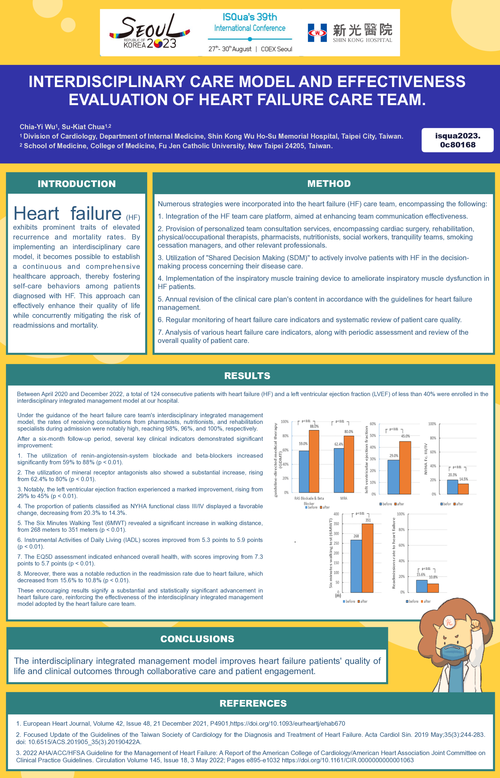
Between April 2020 and December 2022, a total of 124 consecutive patients with heart failure (HF) and a left ventricular ejection fraction (LVEF) of less than 40% were enrolled in the interdisciplinary integrated management model at our hospital.
Under the guidance of the heart failure care team's interdisciplinary integrated management model, the rates of receiving consultations from pharmacists, nutritionists, and rehabilitation specialists during admission were notably high, reaching 98%, 96%, and 100%, respectively.
After a six-month follow-up period, several key clinical indicators demonstrated significant improvement:
1. The utilization of renin-angiotensin-system blockade and beta-blockers increased significantly from 59% to 88% (p < 0.01).
2. The utilization of mineral receptor antagonists also showed a substantial increase, rising from 62.4% to 80% (p < 0.01).
3. Notably, the left ventricular ejection fraction experienced a marked improvement, rising from 29% to 45% (p < 0.01).
4. The proportion of patients classified as NYHA functional class III/IV displayed a favorable change, decreasing from 20.3% to 14.3%.
5. The Six Minutes Walking Test (6MWT) revealed a significant increase in walking distance, from 268 meters to 351 meters (p < 0.01).
6. Instrumental Activities of Daily Living (IADL) scores improved from 5.3 points to 5.9 points (p < 0.01).
7. The EQ5D assessment indicated enhanced overall health, with scores improving from 7.3 points to 5.7 points (p < 0.01).
8. Moreover, there was a notable reduction in the readmission rate due to heart failure, which decreased from 15.6% to 10.8% (p < 0.01).
These encouraging results signify a substantial and statistically significant advancement in heart failure care, reinforcing the effectiveness of the interdisciplinary integrated management model adopted by the heart failure care team.
CONCLUSIONS
The interdisciplinary integrated management model improves heart failure patients' quality of life and clinical outcomes through collaborative care and patient engagement.