Loading...

708 posters, 8 topics, 16 sessions, 1,190 authors, 600 institutions

ePostersLive by SciGen Technologies S.A. All rights reserved.

ISQua's 39th International Conference 2023

August 27 - 30, 2023 | Seoul, Republic of Korea

ISQua's 39th International Conference 2023 banner

P076

A NEW MODALITY IN THE ARMAMENTARIUM FOR EVALUATION OF FEVER OF UNKNOWN ORIGIN: THE ROLE OF 18 - FDG - PET-CT
Part of Topic

Patient Safety & Quality Improvement

TITLE

A New Modality in the Armamentarium for Evaluation Of Fever of Unknown Origin: The role of 18 FDG - PET- CT

INTRODUCTION

•18F- FDG PET CT is a non-invasive nuclear medicine modality utilized for the purpose of identifying the occult disease foci in patients presenting as fever of unknown origin (FUO).
•FDG accumulates in tissues with a high rate of glycolysis, which occurs in malignant cells, activated leukocytes thereby permitting the imaging of acute and chronic inflammatory processes.

Primary objective:

     To evaluate the clinical and diagnostic significance of

     FDG PET-CT in a patient with FUO.

Secondary objective:

    To perform statistical analysis for the prediction value of

    PET-CT in arriving at a diagnosis in FUO.

MATERIALS AND METHODS

•Study Design: Prospective cohort study
•Study group: Patients admitted in Aster Medcity, Kochi.
•Study duration: two years
•Sample size: 77

Inclusion criteria: Patients above the age of 18 years fulfilling the criteria for FUO:

   1) Fever more than 38.3C/101 F on at least two occasions.

   2) Illness duration of more than 3 weeks.

   3) No known immunocompromised state

   4) Diagnosis that remains unknown after a thorough history taking, physical examination and intense inpatient investigations.

Exclusion criteria:

    1) Patients below the age of 18 years.

    2) Pregnant ladies

    3) Patients known to have Malignancy and HIV infection.

    4) Patients who had undergone surgery in the past 3 months.

•Data collection method: Patient interview and Electronic medical records.
 
RESULT
 
•77 eligible patients; 8 have lost to follow up.
•Mean age - 50.1± 16.45 years-  52 male and 25 female
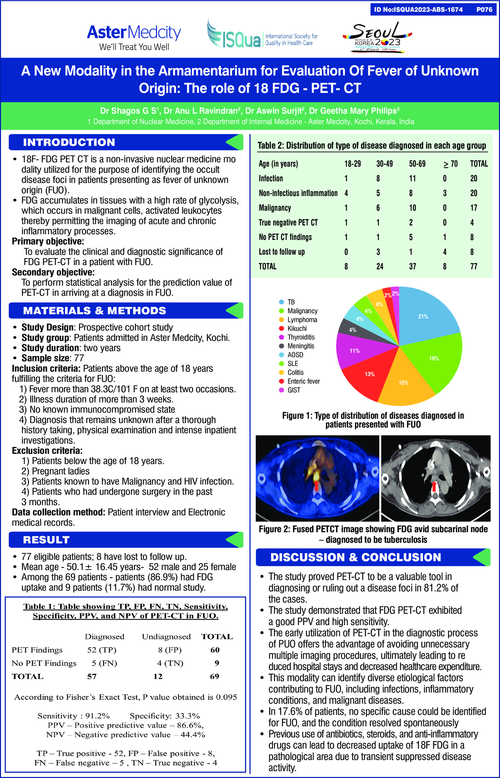
•Among the 69 patients - patients (86.9%) had FDG uptake and 9 patients (11.7%) had normal study.
 
DISCUSSION AND CONCLUSION
 
•The study proved PET-CT to be a valuable tool in diagnosing or ruling out a disease foci in 81.2% of the cases. 
•The study demonstrated that FDG PET-CT exhibited a good PPV and high sensitivity.
•The early utilization of PET-CT in the diagnostic process of PUO offers the advantage of avoiding unnecessary multiple imaging procedures, ultimately leading to reduced hospital stays and decreased healthcare expenditure.
•This modality can identify diverse etiological factors contributing to FUO, including infections, inflammatory conditions, and malignant diseases.
•In 17.6% of patients, no specific cause could be identified for FUO, and the condition resolved spontaneously
•Previous use of antibiotics, steroids, and anti-inflammatory drugs can lead to decreased uptake of 18F FDG in a pathological area due to transient suppressed disease activity.
ISQua's 39th International Conference 2023 » banner
Copyright © 2015-2026, ePostersLive® SciGen is a registered trademark of SciGen Technologies S.A. Patent pending.

This website and third-party tools we use rely on cookies for the best user experience. By selecting "I agree", you agree to cookie usage as described in our Privacy Policy.