708 posters, 8 topics, 16 sessions, 1,190 authors, 600 institutions
ePostersLive by SciGen Technologies S.A. All rights reserved.
ISQua's 39th International Conference 2023
August 27 - 30, 2023 | Seoul, Republic of Korea

P071
DRIVING PERFORMANCE IMPROVEMENT USING INSIGHTS FROM DATA ANALYTICS - A CASE STUDY INVOLVING SERIOUS INCIDENT NOTIFICATIONS IN AGED CARE
Poster Presenter
Authors
Affiliations
Part of Topic
Patient Safety & Quality Improvement
Driving performance improvement using insights from data analytics: A case study involving serious incident notifications in aged care
Ann Wunsch | Executive Director, Approvals and Serious Incident Notifications, Aged Care Quality and Safety Commission, Sydney, Australia
Introduction
Australian facilities providing long-term care for frail older people (residential aged care) are required to deliver care that protects and enhances individuals’ safety, health, wellbeing, and quality of life. An important risk indicator in residential aged care is the occurrence of serious incidents affecting residents.
The Aged Care Quality and Safety Commission (Commission), as the Australian regulator of aged care, has responsibility for receiving, risk assessing and responding to serious incident notifications submitted by aged care providers. The eight serious incident notification types are set out in Exhibit 1. The Commission is using data analytics to develop system-wide Insight reports on serious incidents to prompt providers to examine and strengthen their risk culture.
Methodology
Requiring providers of residential aged care in Australia to submit serious incident notifications presents a unique opportunity for the Commission to obtain and analyse information, and to understand a range of specific risks to aged care residents. Reflecting the findings of this analysis back to the sector as Insight reports provides information and analysis to providers that they cannot otherwise access. It aims to encourage them to examine their own data, compare it with the sector-wide data and understand serious incidents in context.
Informed by behavioural economics principles1,2, the Commission uses this process to ‘nudge’ providers to take action to keep their residents safe and protect them from harm. The Insights reports serve as levers to motivate providers to change their behaviour and strategies based on their instinctive preference to remain within norms.
Exhibit 1 shows that unreasonable use of force accounts for 61% of serious incident notifications. Where a provider deviates significantly from this reporting rate, the Commission’s analytical processes identify the service as a provider of interest. The reasons for the deviation warrant examination.
References
1. Thaler, RH. Misbehaving: The making of behavioural economics. New York, (USA): W.W. Norton & Company; 2015.
2. Lunn, P. Regulatory policy and behavioural economics. Paris (France): OECD Publishing; 2014.
Unreasonable use of force (UUoF) serious incidents
Unreasonable use of force is physical contact with an aged care resident ranging from unwarranted physical force to a deliberate and violent physical attack. To be notified to the Commission, unreasonable use of force must occur in connection with the provision of aged care. There are no limits on who is alleged, suspected or known to have used unreasonable force with a resident.
UUoF Insights report
The Insights report on UUoF (see QR code) presents data and analysis of 24,437 serious incident notifications submitted between 1 April 2021 and 30 June 2022 (an earlier period than the data in Exhibit 1).
The report indicates that 86% of UUoF notifications were resident-to-resident incidents usually involving a component of cognitive impairment in one or both parties, and behaviour management issues. Furthermore, most of these incidents were reported to have had no or minor harm or impact (physical and psychological).
The report provides illustrative case studies and learning prompts using guided questions. The focus is on the importance of proactive behaviour support planning where residents have challenging behaviours. The report also provides guidance on responding to incidents, and specifically on the importance of not relying exclusively on a resident’s recall or account of their experience when assessing the impact of an incident. As at 15 March 2023, the report had 1,052 unique downloads from the Commission’s website.
Assessing impact and further analysis
It is not straightforward to assess the impact of the UUoF Insights Report on providers’ efforts to reduce the risk of this type of serious incident occurring or impacting residents.
The Commission continues to monitor and analyse serious incident notification data to identify any shifts in the volume or proportion of each serious incident type.
Further, different analyses are being undertaken on more recent data to assist the Commission to identify and focus on higher-risk providers:
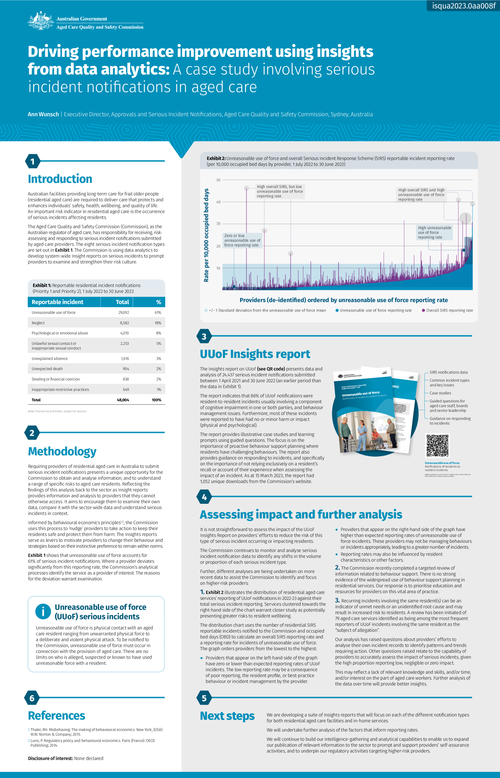
1. Exhibit 2 illustrates the distribution of residential aged care services’ reporting of UUoF notifications in 2022- 23 against their total serious incident reporting. Services clustered towards the right-hand side of the chart warrant closer study as potentially presenting greater risks to resident wellbeing.
The distribution chart uses the number of residential SIRS reportable incidents notified to the Commission and occupied bed days (OBD) to calculate an overall SIRS reporting rate and a reporting rate for incidents of unreasonable use of force. The graph orders providers from the lowest to the highest:
● Providers that appear on the left-hand side of the graph have zero or lower than expected reporting rates of UUoF incidents. The low reporting rate may be a consequence of poor reporting, the resident profile, or best-practice behaviour or incident management by the provider.
● Providers that appear on the right-hand side of the graph have higher than expected reporting rates of unreasonable use of force incidents. These providers may not be managing behaviours or incidents appropriately, leading to a greater number of incidents.
● Reporting rates may also be influenced by resident characteristics or other factors.
2. The Commission recently completed a targeted review of information related to behaviour support. There is no strong evidence of the widespread use of behaviour support planning in residential services. Our response is to prioritise education and resources for providers on this vital area of practice.
3. Recurring incidents involving the same resident(s) can be an indicator of unmet needs or an unidentified root cause and may result in increased risk to residents. A review has been initiated of 79 aged care services identified as being among the most frequent reporters of UUoF incidents involving the same resident as the "subject of allegation".
Our analysis has raised questions about providers’ efforts to analyse their own incident records to identify patterns and trends requiring action. Other questions raised relate to the capability of providers to accurately assess the impact of serious incidents, given the high proportion reporting low, negligible or zero impact.
This may reflect a lack of relevant knowledge and skills, and/or time, and/or interest on the part of aged care workers. Further analysis of the data over time will provide better insights.
Next steps
We are developing a suite of Insights reports that will focus on each of the different notification types for both residential aged care facilities and in-home services.
We will undertake further analysis of the factors that inform reporting rates.
We will continue to build our intelligence-gathering and analytical capabilities to enable us to expand our publication of relevant information to the sector to prompt and support providers’ self-assurance activities, and to underpin our regulatory activities targeting higher-risk providers.