708 posters, 8 topics, 16 sessions, 1,190 authors, 600 institutions
ePostersLive by SciGen Technologies S.A. All rights reserved.
ISQua's 39th International Conference 2023
August 27 - 30, 2023 | Seoul, Republic of Korea

P064
RISK-BASED SUPPLY CHAIN MANAGEMENT FRAMEWORK IN THE HEALTHCARE INDUSTRY
Poster Presenter
Authors
Affiliations
Part of Topic
Patient Safety & Quality Improvement
Risk-Based Supply Chain Management Framework in the Healthcare Industry
BACKGROUND
Supply chain management in the healthcare industry refers to the coordinated effort of managing the flow of medical inventories, services, and information from suppliers to healthcare providers, and ultimately to patients.
It plays a crucial role in ensuring that hospitals have the necessary resources to deliver high-quality patient care effectively. Effective supply chain management can result in cost savings, improved patient outcomes, and enhanced overall operational efficiency.
There is an increase in the use of counterfeit supplies in healthcare because the supply is not manufactured within the country and will take time to acquire supplies in the event of an emergency. When supplies are scarce, expensive, or from a single source, the chance of counterfeit increases. Efficient supply chain management could improve overall operations by avoiding malfunctions, contamination, or instability in the supply or equipment that could jeopardize patient safety.
AIM
To examine the performance of the Supply Chain Management Framework and the major players in the supply chain in the National Heart Institute, Malaysia.
CONCEPT
The fundamentals of the supply chain include manufacturers, transportation, distributors, retailers and customers, with the focus on ensuring high-quality patient care.
METHODOLOGY
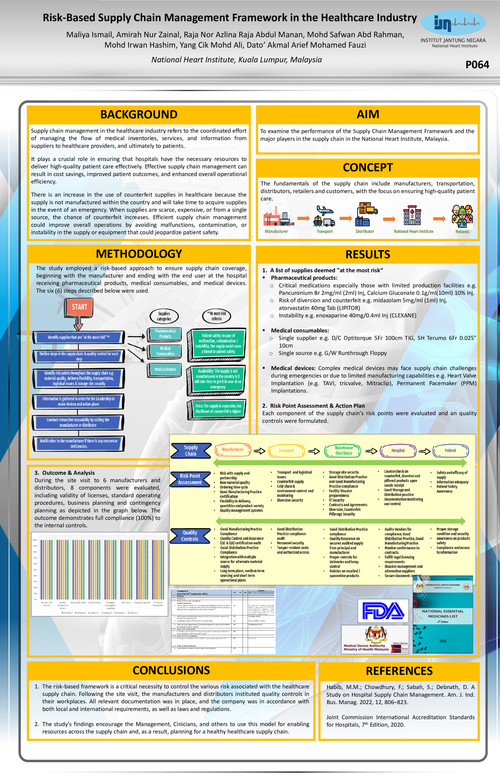
The study employed a risk-based approach to ensure supply chain coverage, beginning with the manufacturer and ending with the end user at the hospital receiving pharmaceutical products, medical consumables, and medical devices. The six (6) steps described below were used.
RESULTS
Medical devices: Complex medical devices may face supply chain challenges during emergencies or due to limited manufacturing capabilities e.g. Heart Valve Implantation (e.g. TAVI, tricvalve, Mitraclip), Permanent Pacemaker (PPM) Implantations.
Each component of the supply chain's risk points were evaluated and an quality controls were formulated.
During the site visit to 6 manufacturers and distributors, 8 components were evaluated, including validity of licenses, standard operating procedures, business planning and contingency planning as depicted in the graph below. The outcome demonstrates full compliance (100%) to the internal controls.
CONCLUSIONS
1. Habib, M.M.; Chowdhury, F.; Sabah, S.; Debnath, D. A Study on Hospital Supply Chain Management. Am. J. Ind. Bus. Manag. 2022, 12, 806–823.
2. Joint Commission International Accreditation Standards for Hospitals, 7th Edition, 2020.