708 posters, 8 topics, 16 sessions, 1,190 authors, 600 institutions
ePostersLive by SciGen Technologies S.A. All rights reserved.
ISQua's 39th International Conference 2023
August 27 - 30, 2023 | Seoul, Republic of Korea

P057
RETROSPECTIVE CHART REVIEW OF CARDIAC ARREST EVENTS IN NON-CRITICAL, OUT-PATIENT, AND NON-CLINICAL AREAS TO MESURE TIMELINESS OF RESPONSE
Poster Presenter
Authors
Affiliations
Part of Topic
Patient Safety & Quality Improvement
RETROSPECTIVE CHART REVIEW OF CARDIAC ARREST EVENTS IN NON-CRITICAL, OUT-PATIENT, AND NON-CLINICAL AREAS TO MEASURE TIMELINESS OF RESPONSE
Authors: A. LAMPA1, M. STA. ANA1, and A. Flores III2
1 Clinical Safety and Risk Management, Makati Medical Center, Makati City, National Capital Region, Philippines
2 Department of Emergency Medicine. Makati Medical Center, Makati City, National Capital Region, Philippines
INTRODUCTION:
Research shows that early initiation of Basic Life Support (BLS) increases the probability of survival for a victim of cardiac arrest. According to American Heart Association (AHA), the passage of time drives all aspect of Emergency Cardiovascular Care. The final outcomes are determined by the intervals between collapse or onset of the emergency and the delivery of basic and advanced interventions. The probability of survival declines sharply with each passing minute of cardiopulmonary compromise. In another research, response times and CPR skills competency significantly decrease as early as three months after training is completed. Makati Medical Center’s Resuscitation Services Program aims to provide Basic Life Support immediately upon recognition of cardiac arrest and Advance Life Support in less than five (5) minutes. Resuscitation drills are conducted hospital-wide to assess the skills of healthcare workers and measure their response time. However, during the COVID-19 pandemic, conduct of face-to-face emergency drills was put on hold to prevent the spread of infection. This is also in compliance with the National Government’s directives prohibiting the conduct of mass gatherings and practice of stringent social distancing measures. During this time, there was no other hospital activity being implemented that monitors the response time of the resuscitation team.
METHOD:
To measure timeliness of response:
• The Clinical Emergency Preparedness Committee assigned members who will collect and collate the data.
• The hospital’s Call Center provides the Committee with a monthly report where all emergency codes activated by a unit/ department are listed.
• The Committee forwards the report to Nursing and Patient Care Services and Out-Patient Departments for collection of patient identifiers.
• Committee members conduct retrospective chart review to gather the following data: onset of cardiac arrest, time Emergency Code was activated, time CPR was initiated, time the Resuscitation Team arrived, and the time ACLS was started.
• Data are then analyzed to identify the interval between onset of cardiac arrest and initiation of chest compression, interval between onset of cardiac arrest and arrival of the emergency response team, and the interval between the onset of cardiac arrest and the initiation of ACLS.
• Results are then presented to the Committee where gaps and areas of improvement are identified.
• The Committee developed action plans to improve response time and prevent the recurrence of delay. Results of the retrospective chart review and action plan were also provided to all units and departments.
Results:
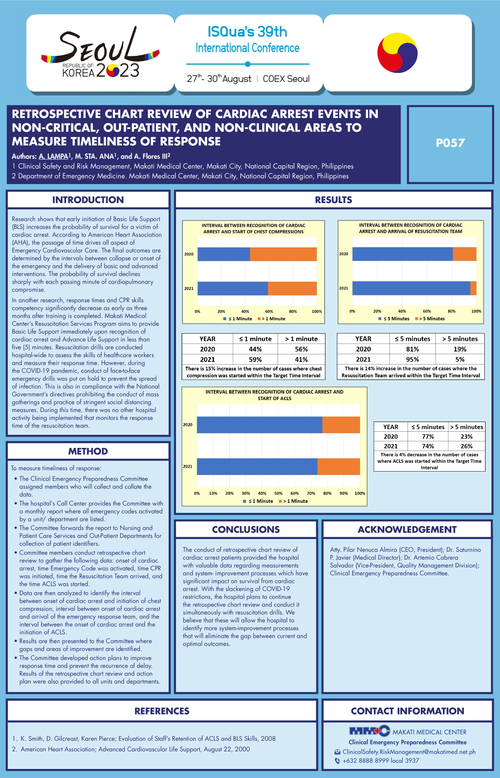
Interval Between Recognition of Cardiac Arrest and Start of Chest Compressions
Less than or equal to 1 minute: 2020- 44% 2021-59%
More than1 minute: 2020- 56% 2021- 41%
Interval between Recognition of Cardiac Arrest and Arrival of Resuscitation Team
Less than or equal to 5 minutes: 2020- 81% 2021- 95%
More tha 5 minutes: 2020- 19% 202-5%
Interval between Recognition of Cardiac Arrest and Start of ACLS
Less than or Equal to 5 minutes: 2020- 77% 2021- 74%
More tha 5 minutes: 2020- 23% 2021- 26%
CONCLUSION:
The conduct of retrospective chart review of cardiac arrest patients provided the hospital with valuable data regarding measurements and system- improvement processes which have significant impact on survival from cardiac arrest. With the slackening of COVID-19 restrictions, the hospital plans to continue the retrospective chart review and conduct it simultaneously with resuscitation drills. We believe that these will allow the hospital to identify more system-improvement processes that will eliminate the gap between current and optimal outcomes.
ACKNOWLEDGEMENT:
Atty. Pilar Nenuca Almira (CEO, President); Dr. Saturnino P. Javier (Medical Director); Dr. Artemio Cabrera Salvador (Vice-President, Quality Management Division); Clinical Emergency Preparedness Committee.
REFERENCES:
1. K. Smith, D. Gilcreast, Karen Pierce; Evaluation of Staff’s Retention of ACLS and BLS Skills, 2008
2. American Heart Association; Advanced Cardiovascular Life Support, August 22, 2000
CONTACT INFORMATION:
Makati Medical Center
Clinical Emergency Preparedness Committee
Email:ClinicalSafety.RiskManagement@makatimed.net.ph
Telephone Number +63 2 8888 8999 local 3937
Address: #2 Amorsolo Street, Legazpi Village, Makati City, National Capital Region, Philippines 1229