708 posters, 8 topics, 16 sessions, 1,190 authors, 600 institutions
ePostersLive by SciGen Technologies S.A. All rights reserved.
ISQua's 39th International Conference 2023
August 27 - 30, 2023 | Seoul, Republic of Korea

P053
PREDICTION OF PATIENTS’ LENGTH OF STAY AFTER SURGERY USING MULTI-MODEL-ENSEMBLES
Poster Presenter
Part of Topic
Digital Healthcare and Innovation
Prediction of Patients’ Length of Stay after Surgery using Multi-Model-Ensembles
J. VETTER1, M. STROBL1, G. HALMERBAUER2, and S. WINKLER1
1 Bioinformatics Research Group, University of Applied Sciences Upper Austria, Hagenberg, Austria
2 Process Management and Business Intelligence, University of Applied Sciences Upper Austria, Steyr, Austria
INTRODUCTION
Bed management plays a crucial role in hospitals. Up to now, available bed management software mainly allows for recording occupied beds, but there is no forecast about when beds will be unoccupied. Since 2015, University of Applied Sciences Upper Austria and Oberösterreichische Gesundheitsholding (OÖG) have developed the benchmarking platform LeistungsVergleich Medizin (LeiVMed) to provide transparency concerning morbidity and mortality, processes, and cost of care in hospitals in Upper Austria. [1, 2] The data collected comprise more than
200 000 patients and include specific medical data (e.g., risk factors and complications) about patients and services provided before surgery, during their stay, and after discharge.
AIM
We investigate the feasibility of predicting the length of stay (LOS) of individual patients after surgery using a multi-model ensemble (MME) machine learning (ML) approach. Early and accurate prediction of the LOS shows great potential for improved scheduling, resource planning, and cost reduction.
METHODS
For modeling, information of more than 200 000 patients who underwent one out of 27 different surgeries was used. Models were learned that are able to predict the patients’ LOS. These ML models were trained with classification and regression algorithms and were combined in a MME. Eight classes to categorize the LOS after surgery were defined: 1, 2, 3, 4, 5, 6 days, 7 to 30 days, and > 30 days. MMEs were generated using data before, on the surgery day, and up to seven days after surgery.
RESULTS
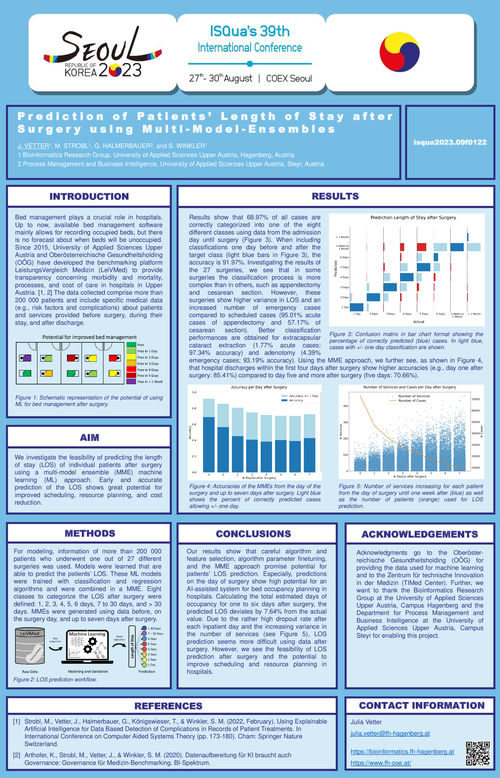
Results show that 68.97% of all cases are correctly categorized into one of the eight different classes using data from the admission day until surgery (Figure 3). When including classifications one day before and after the target class (light blue bars in Figure 3), the accuracy is 91.97%. Investigating the results of the 27 surgeries, we see that in some surgeries the classification process is more complex than in others, such as appendectomy and cesarean section. However, these surgeries show higher variance in LOS and an increased number of emergency cases compared to scheduled cases (95.01% acute cases of appendectomy and 57.17% of cesarean section). Better classification performances are obtained for extracapsular cataract extraction (1.77% acute cases; 97.34% accuracy) and adenotomy (4.39% emergency cases; 93.19% accuracy). Using the MME approach, we further see, as shown in Figure 4, that hospital discharges within the first four days after surgery show higher accuracies (e.g., day one after surgery: 85.41%) compared to day five and more after surgery (five days: 70.66%).
CONCLUSIONS
Our results show that careful algorithm and feature selection, algorithm parameter finetuning, and the MME approach promise potential for patients’ LOS prediction. Especially, predictions on the day of surgery show high potential for an AI-assisted system for bed occupancy planning in hospitals. Calculating the total estimated days of occupancy for one to six days after surgery, the predicted LOS deviates by 7.64% from the actual value. Due to the rather high dropout rate after each inpatient day and the increasing variance in the number of services (see Figure 5), LOS prediction seems more difficult using data after surgery. However, we see the feasibility of LOS prediction after surgery and the potential to improve scheduling and resource planning in hospitals.
ACKNOWLEDGEMENTS
Acknowledgments go to the Oberöster-reichische Gesundheitsholding (OÖG) for providing the data used for machine learning and to the Zentrum für technische Innovation in der Medizin (TIMed Center). Further, we want to thank the Bioinformatics Research Group at the University of Applied Sciences Upper Austria, Campus Hagenberg and the Department for Process Management and Business Intelligence at the University of Applied Sciences Upper Austria, Campus Steyr for enabling this project.
REFERENCES
[1] Strobl, M., Vetter, J., Halmerbauer, G., Königswieser, T., & Winkler, S. M. (2022, February). Using Explainable Artificial Intelligence for Data Based Detection of Complications in Records of Patient Treatments. In International Conference on Computer Aided Systems Theory (pp. 173-180). Cham: Springer Nature Switzerland.
[2] Arthofer, K., Strobl, M., Vetter, J., & Winkler, S. M. (2020). Datenaufbereitung für KI braucht auch Governance: Governance für Medizin-Benchmarking. BI-Spektrum.
CONTACT INFORMATION
Julia Vetter