Loading...

708 posters, 8 topics, 16 sessions, 1,190 authors, 600 institutions

ePostersLive by SciGen Technologies S.A. All rights reserved.

ISQua's 39th International Conference 2023

August 27 - 30, 2023 | Seoul, Republic of Korea

ISQua's 39th International Conference 2023 banner

P041

APPLY OF SMART INTRADIALYTIC HYPOTENSION ALARM SYSTEM TO IMPROVE THE MEDICAL QUALITY IN HEMODIALYSIS UNIT
Part of Topic

Digital Healthcare and Innovation

Apply of Smart Intradialytic hypotension alert system to improve the quality of life of dialysis patients 


Background 

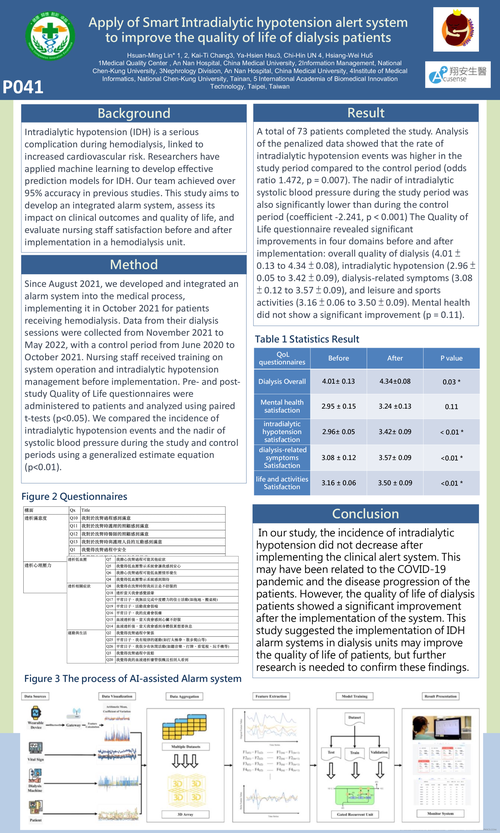
Intradialytic hypotension (IDH) is a serious complication during hemodialysis, linked to increased cardiovascular risk. Researchers have applied machine learning to develop effective prediction models for IDH. Our team achieved over 95% accuracy in previous studies. This study aims to develop an integrated alarm system, assess its impact on clinical outcomes and quality of life, and evaluate nursing staff satisfaction before and after implementation in a hemodialysis unit. 


Method 

Since August 2021, we developed and integrated an alarm system into the medical process, implementing it in October 2021 for patients receiving hemodialysis. Data from their dialysis sessions were collected from November 2021 to May 2022, with a control period from June 2020 to October 2021. Nursing staff received training on system operation and intradialytic hypotension management before implementation. Pre- and post- study Quality of Life questionnaires were administered to patients and analyzed using paired t-tests (p<0.05). We compared the incidence of intradialytic hypotension events and the nadir of systolic blood pressure during the study and control periods using a generalized estimate equation (p<0.01). 


Result 

A total of 73 patients completed the study. Analysis of the penalized data showed that the rate of intradialytic hypotension events was higher in the study period compared to the control period (odds ratio 1.472, p = 0.007). The nadir of intradialytic systolic blood pressure during the study period was also significantly lower than during the control period (coefficient -2.241, p < 0.001) The Quality of Life questionnaire revealed significant improvements in four domains before and after implementation: overall quality of dialysis (4.01 ± 0.13 to 4.34 ± 0.08), intradialytic hypotension (2.96 ± 0.05 to 3.42 ± 0.09), dialysis-related symptoms (3.08 ± 0.12 to 3.57 ± 0.09), and leisure and sports activities (3.16 ± 0.06 to 3.50 ± 0.09). Mental health did not show a significant improvement (p = 0.11). 


Conclusion 

In our study, the incidence of intradialytic hypotension did not decrease after implementing the clinical alert system. This may have been related to the COVID-19 pandemic and the disease progression of the patients. However, the quality of life of dialysis patients showed a significant improvement after the implementation of the system. This study suggested the implementation of IDH alarm systems in dialysis units may improve the quality of life of patients, but further research is needed to confirm these findings. 


ISQua's 39th International Conference 2023 » banner
Copyright © 2015-2026, ePostersLive® SciGen is a registered trademark of SciGen Technologies S.A. Patent pending.

This website and third-party tools we use rely on cookies for the best user experience. By selecting "I agree", you agree to cookie usage as described in our Privacy Policy.