708 posters, 8 topics, 16 sessions, 1,190 authors, 600 institutions
ePostersLive by SciGen Technologies S.A. All rights reserved.
ISQua's 39th International Conference 2023
August 27 - 30, 2023 | Seoul, Republic of Korea

P040
BUILD-UP THE ACTIVE RENAL DOSING SYSTEM TO IMPROVE PATIENTS’ MEDICATION SAFETY
Poster Presenter
Authors
Affiliations
Part of Topic
Digital Healthcare and Innovation
INTRODUCTION
In order to ensure the safety of medication use, the COPE system of Taipei Medical University Hospital has been established with many functions for medication safety, such as duplication of medicines, history of drug allergies, maximum dose examination, reminders for dose adjustment in accordance to hepatic and renal function, and etc....After analyzing data of inappropriate prescriptions in 2021, we found there was 46.1% near-miss prescriptions related to renal function adjustment, even we has been established reminding system for renal dosing. Therefore, we decided to strengthen renal dosing system on CPOE.
METHOD
We constructed the Active Renal Dosing System in Mar. 2022. First, the system will calculate patient’s ClCr by using the newest serum creatinine data within one year. Then the system provides a list of appropriate dosage in accordance to patient’s renal function for the prescribers to choose. However, prescribers gave us feedback that the system is good, but there were too many message windows on CPOE already and they don’t have enough time to read each piece of information then cause information fatigue.
Therefore, we modified the system in Nov. 2022, that when prescriber inputs drug name, the system will take default value automatically according to patient’s renal function in the prescription, prescriber need not to choose on the list anymore. But once there is any special indication or purpose, prescribers still can modify the dose and frequency of the medication.
RESULTS
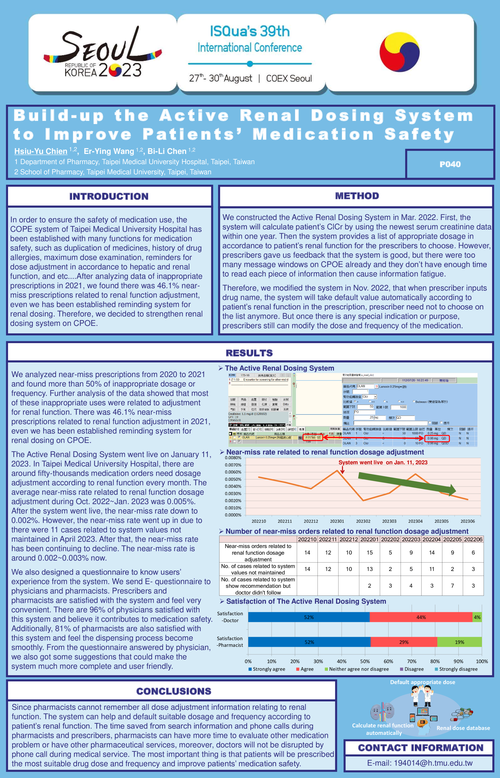
We analyzed near-miss prescriptions from 2020 to 2021 and found more than 50% of inappropriate dosage or frequency. Further analysis of the data showed that most of these inappropriate uses were related to adjustment for renal function. There was 46.1% near-miss prescriptions related to renal function adjustment in 2021, even we has been established reminding system for renal dosing on CPOE.
The Active Renal Dosing System went live on January 11, 2023. In Taipei Medical University Hospital, there are around fifty-thousands medication orders need dosage adjustment according to renal function every month. The average near-miss rate related to renal function dosage adjustment during Oct. 2022~Jan. 2023 was 0.005%. After the system went live, the near-miss rate down to 0.002%. However, the near-miss rate went up in due to there were 11 cases related to system values not maintained in April 2023. After that, the near-miss rate has been continuing to decline. The near-miss rate is around 0.002~0.003% now.
We also designed a questionnaire to know users’ experience from the system. We send E- questionnaire to physicians and pharmacists. Prescribers and pharmacists are satisfied with the system and feel very convenient. There are 96% of physicians satisfied with this system and believe it contributes to medication safety. Additionally, 81% of pharmacists are also satisfied with this system and feel the dispensing process become smoothly. From the questionnaire answered by physician, we also got some suggestions that could make the system much more complete and user friendly.
CONCLUSIONS
Since pharmacists cannot remember all dose adjustment information relating to renal function. The system can help and default suitable dosage and frequency according to patient’s renal function. The time saved from search information and phone calls during pharmacists and prescribers, pharmacists can have more time to evaluate other medication problem or have other pharmaceutical services, moreover, doctors will not be disrupted by phone call during medical service. The most important thing is that patients will be prescribed the most suitable drug dose and frequency and improve patients’ medication safety.