708 posters, 8 topics, 16 sessions, 1,190 authors, 600 institutions
ePostersLive by SciGen Technologies S.A. All rights reserved.
ISQua's 39th International Conference 2023
August 27 - 30, 2023 | Seoul, Republic of Korea

P038
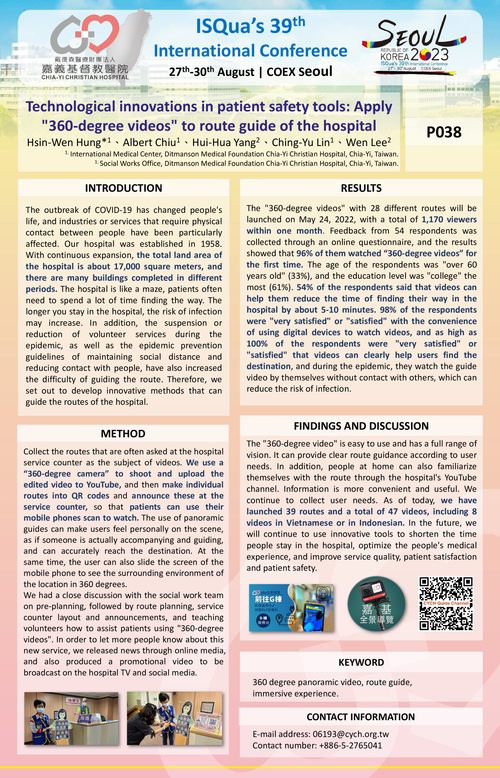
TECHNOLOGICAL INNOVATIONS IN PATIENT SAFETY TOOLS: APPLY "360-DEGREE VIDEOS" TO ROUTE GUIDE OF THE HOSPITAL
Poster Presenter
Authors
Affiliations
Part of Topic
Digital Healthcare and Innovation
Technological innovations in patient safety tools: Apply "360-degree videos" to route guide of the hospital
Hsin-Wen Hung1、Albert Chiu1、Hui-Hua Yang2、Ching-Yu Lin1、Wen Lee2
Ditmanson Medical Foundation Chia-Yi Christian Hospital
International Medical Center1、Social Works Office2
Introduction:
The outbreak of COVID-19 has changed people's life, and industries or services that require physical contact between people have been particularly affected. Our hospital was established in 1958. With continuous expansion, the total land area of the hospital is about 17,000 square meters, and there are many buildings completed in different periods. The hospital is like a maze, patients often need to spend a lot of time finding the way. The longer you stay in the hospital, the risk of infection may increase. In addition, the suspension or reduction of volunteer services during the epidemic, as well as the epidemic prevention guidelines of maintaining social distance and reducing contact with people, have also increased the difficulty of guiding the route. Therefore, we set out to develop innovative methods that can guide the routes of the hospital.
Methods:
Collect the routes that are often asked at the hospital service counter as the subject of videos. We use a “360-degree camera” to shoot and upload the edited video to YouTube, and then make individual routes into QR codes and announce these at the service counter, so that patients can use their mobile phones scan to watch. The use of panoramic guides can make users feel personally on the scene, as if someone is actually accompanying and guiding, and can accurately reach the destination. At the same time, the user can also slide the screen of the mobile phone to see the surrounding environment of the location in 360 degrees.
We had a close discussion with the social work team on pre-planning, followed by route planning, service counter layout and announcements, and teaching volunteers how to assist patients using "360-degree videos". In order to let more people know about this new service, we released news through online media, and also produced a promotional video to be broadcast on the hospital TV and social media.
Results:
The "360-degree videos" with 28 different routes will be launched on May 24, 2022, with a total of 1,170 viewers within one month. Feedback from 54 respondents was collected through an online questionnaire, and the results showed that 96% of them watched “360-degree videos” for the first time. The age of the respondents was "over 60 years old" (33%), and the education level was "college" the most (61%). 54% of the respondents said that videos can help them reduce the time of finding their way in the hospital by about 5-10 minutes. 98% of the respondents were "very satisfied" or "satisfied" with the convenience of using digital devices to watch videos, and as high as 100% of the respondents were "very satisfied" or "satisfied" that videos can clearly help users find the destination, and during the epidemic, they watch the guide video by themselves without contact with others, which can reduce the risk of infection.
Conclusion:
The "360-degree video" is easy to use and has a full range of vision. It can provide clear route guidance according to user needs. In addition, people at home can also familiarize themselves with the route through the hospital's YouTube channel. Information is more convenient and useful. We continue to collect user needs. As of today, we have launched 33 routes and a total of 41 videos, including 8 videos in Vietnamese or in Indonesian. In the future, we will continue to use innovative tools to shorten the time people stay in the hospital, optimize the people's medical experience, and improve service quality, patient satisfaction and patient safety.
Keywords:
360 degree panoramic video, route guide, immersive experience.