708 posters, 8 topics, 16 sessions, 1,190 authors, 600 institutions
ePostersLive by SciGen Technologies S.A. All rights reserved.
ISQua's 39th International Conference 2023
August 27 - 30, 2023 | Seoul, Republic of Korea

P029
ORAL HEALTH VIRTUAL ASSISTANT SUPPORTED BY ARTIFICIAL INTELLIGENCE
Poster Presenter
Part of Topic
Digital Healthcare and Innovation
[P029] Oral Health Virtual Assistant Supported by Artificial Intelligence -
F. GASTAL1, F. NOGI2, OLIVEIRA JUNIOR O.B3, C.ROSA4
INTRODUCTION
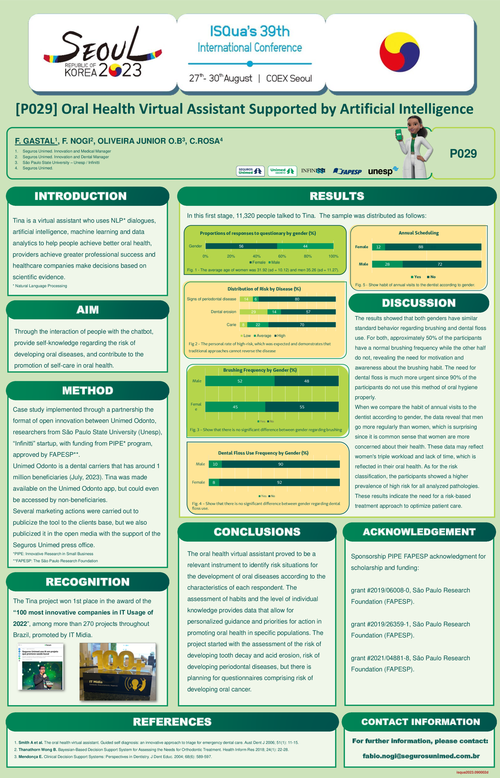
Tina is a virtual assistant who uses NLP* dialogues, artificial intelligence, machine learning and data analytics to help people achieve better oral health, providers achieve greater professional success and healthcare companies make decisions based on scientific evidence.
* Natural Language Processing
AIM
Through the interaction of people with the chatbot, provide self-knowledge regarding the risk of developing oral diseases, and contribute to the promotion of self-care in oral health.
METHOD
Case study implemented through a partnership the format of open innovation between Unimed Odonto, researchers from São Paulo State University (Unesp), “Infinitti” startup, with funding from PIPE* program, approved by FAPESP**.
Unimed Odonto is a dental carriers that has around 1 million beneficiaries (July, 2023). Tina was made available on the Unimed Odonto app, but could even be accessed by non-beneficiaries.
Several marketing actions were carried out to publicize the tool to the clients base, but we also publicized it in the open media with the support of the Seguros Unimed press office.
*PIPE: Innovative Research in Small Business
**FAPESP: The São Paulo Research Foundation
RECOGNITION
The Tina project won 1st place in the award of the “100 most innovative companies in IT Usage of 2022”, among more than 270 projects throughout Brazil, promoted by IT Midia.
RESULTS
In this first stage, 11,320 people talked to Tina. The sample was distributed as follows: (IMAGES, GRAPHICS)
DISCUSSION
The results showed that both genders have similar standard behavior regarding brushing and dental floss use. For both, approximately 50% of the participants have a normal brushing frequency while the other half do not, revealing the need for motivation and awareness about the brushing habit. The need for dental floss is much more urgent since 90% of the participants do not use this method of oral hygiene properly.
When we compare the habit of annual visits to the dentist according to gender, the data reveal that men go more regularly than women, which is surprising since it is common sense that women are more concerned about their health. These data may reflect women's triple workload and lack of time, which is reflected in their oral health. As for the risk classification, the participants showed a higher prevalence of high risk for all analyzed pathologies. These results indicate the need for a risk-based treatment approach to optimize patient care.
CONCLUSIONS
The oral health virtual assistant proved to be a relevant instrument to identify risk situations for the development of oral diseases according to the characteristics of each respondent. The assessment of habits and the level of individual knowledge provides data that allow for personalized guidance and priorities for action in promoting oral health in specific populations. The project started with the assessment of the risk of developing tooth decay and acid erosion, risk of developing periodontal diseases, but there is planning for questionnaires comprising risk of developing oral cancer.
ACKNOWLEDGEMENT
Sponsorship PIPE FAPESP acknowledgment for scholarship and funding:
grant #2019/06008-0, São Paulo Research Foundation (FAPESP).
grant #2019/26359-1, São Paulo Research Foundation (FAPESP).
grant #2021/04881-8, São Paulo Research Foundation (FAPESP).
REFERENCES
1. Smith A et al. The oral health virtual assistant. Guided self diagnosis: an innovative approach to triage for emergency dental care. Aust Dent J 2006; 51(1): 11-15.
2. Thanathorn Wong B. Bayesian-Based Decision Support System for Assessing the Needs for Orthodontic Treatment. Health Inform Res 2018; 24(1): 22-28.
3. Mendonça E. Clinical Decision Support Systems: Perspectives in Dentistry. J Dent Educ. 2004; 68(6): 589-597.
CONTACT INFORMATION
For further information, please contact:
fabio.nogi@segurosunimed.com.br
RESULTS