708 posters, 8 topics, 16 sessions, 1,190 authors, 600 institutions
ePostersLive by SciGen Technologies S.A. All rights reserved.
ISQua's 39th International Conference 2023
August 27 - 30, 2023 | Seoul, Republic of Korea

P026
WRIST-WORN WEARABLES FOR MONITORING IN THE PERIOPERATIVE SETTING: VALIDATION STUDY OF HEART RATE AND OXYGEN SATURATION SENSORS
Poster Presenter
Authors
Affiliations
Part of Topic
Digital Healthcare and Innovation
WRIST-WORN WEARABLES FOR MONITORING IN THE PERIOPERATIVE SETTING: VALIDATION STUDY OF HEART RATE AND OXYGEN SATURATION SENSORS
Eduardo Salgado*, Charlotte Köhler, Adam Wolisz, Thorsten Schaaf, Daniel Fürstenau, Felix Balzer, Sylvia Thun, Alexander Bartschke.
Introduction: Wearables have become widespread consumer health products with sensors measuring a wide range of vital signs. Using these to monitor patients in a perioperative setting could bring numerous benefits such as early discharge from the hospital and remote rehabilitation; yet their clinical implementation remains a challenge as their monitoring capabilities need to be validated. This study aims to evaluate the accuracy and validity of heart rate (HR) and oxygen saturation (SpO2) sensors of four popular devices from Apple, Samsung, Garmin, and Withings in comparison with a gold standard monitor currently used in operating rooms and intensive care units.
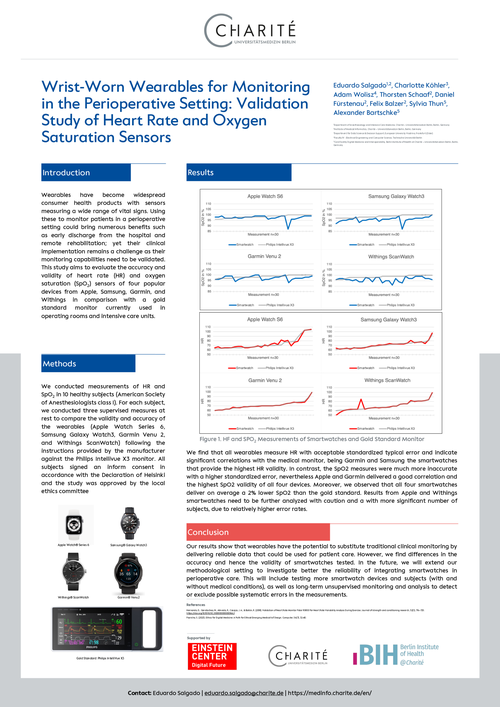
Methods: We conducted measurements of HR and SpO2 in 10 healthy subjects (American Society of Anesthesiologists class I). For each subject, we conducted three supervised measures at rest to compare the validity and accuracy of the wearables (Apple Watch Series 6, Samsung Galaxy Watch3, Garmin Venu 2, and Withings ScanWatch) following the instructions provided by the manufacturer against the Philips Intellivue X3 monitor. All subjects signed an inform consent in accordance with the Declaration of Helsinki and the study was approved by the local ethics committee
Results: We find that all wearables measure HR with acceptable standardized typical error and indicate significant correlations with the medical monitor, being Garmin and Samsung the smartwatches that provide the highest HR validity. In contrast, the SpO2 measures were much more inaccurate with a higher standardized error, nevertheless Apple and Garmin delivered a good correlation and the highest SpO2 validity of all four devices. Moreover, we observed that all four smartwatches deliver on average a 2% lower SpO2 than the gold standard. Results from Apple and Withings smartwatches need to be further analyzed with caution and a with more significant number of subjects, due to relatively higher error rates.
Conclusion: Our results show that wearables have the potential to substitute traditional clinical monitoring by delivering reliable data that could be used for patient care. However, we find differences in the accuracy and hence the validity of smartwatches tested. In the future, we will extend our methodological setting to investigate better the reliability of integrating smartwatches in perioperative care. This will include testing more smartwatch devices and subjects (with and without medical conditions), as well as long-term unsupervised monitoring and analysis to detect or exclude possible systematic errors in the measurements.
Keywords: Wearables, Sensors, Heart Rate, Oxygen Saturation, Perioperative Care, Validation, Accuracy