708 posters, 8 topics, 16 sessions, 1,190 authors, 600 institutions
ePostersLive by SciGen Technologies S.A. All rights reserved.
ISQua's 39th International Conference 2023
August 27 - 30, 2023 | Seoul, Republic of Korea

P024
DIGITAL MULTIDISCIPLINARY MEETINGS ENABLE REGIONAL SPECIALIST ONCOLOGY TREATMENT.
Part of Topic
Digital Healthcare and Innovation
Digital multidisciplinary meetings enable regional specialist oncology treatment.
Background
The technological revolution within the medical field spurred on by the global pandemic has resulted in changes in how healthcare can be delivered. Within the South African medical landscape, the differences in medical care provided to patients due to specialist availability vary widely between different regions within the country. The use of a comprehensive digital support system resulted in a new service provision of multi-disciplinary meeting (MDM) expertise offered to a variety of allied health professionals independent of the region and thus improved MDM access for a greater range of complex breast oncology patients.
Methodology
Existing treatment plans provided for patients attending the Breast Care Centre of Excellence from outside of the reasonable treatment range (3-6 hour travel) were provided via a written report to allied healthcare providers for treatment remotely.
Post-digitalisation, the existing service offering was expanded to include MDMs with recorded treatment discussion, radiological review and pathological support, coupled with interactive treatment decisions provided from top tier academic specialists in the surgical, oncological and radiation fields, allowing for treatment support of regional patients to be provided by the centralised digital MDM team following international guidelines.
Further inclusion of controlled cloud patient database sets, including clinical, radiological and pathological diagnostic information, coupled with outlined treatment plans, provided members with a reference database for treatment and research collaborations.
Results
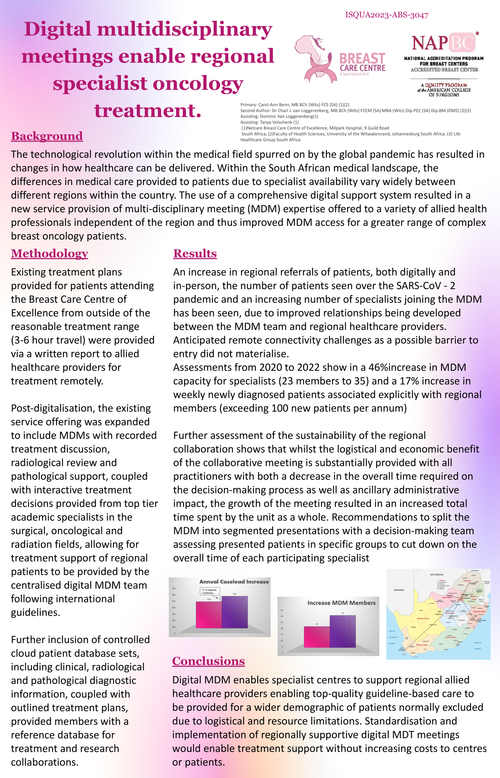
An increase in regional referrals of patients, both digitally and in-person, the number of patients seen over the SARS-CoV - 2 pandemic and an increasing number of specialists joining the MDM has been seen, due to improved relationships being developed between the MDM team and regional healthcare providers. Anticipated remote connectivity challenges as a possible barrier to entry did not materialise.
Assessments from 2020 to 2022 show in a 46%increase in MDM capacity for specialists (23 members to 35) and a 17% increase in weekly newly diagnosed patients associated explicitly with regional members (exceeding 100 new patients per annum)
Further assessment of the sustainability of the regional collaboration shows that whilst the logistical and economic benefit of the collaborative meeting is substantially provided with all practitioners with both a decrease in the overall time required on the decision-making process as well as ancillary administrative impact, the growth of the meeting resulted in an increased total time spent by the unit as a whole. Recommendations to split the MDM into segmented presentations with a decision-making team assessing presented patients in specific groups to cut down on the overall time of each participating specialist
Conclusion
Digital MDM enables specialist centres to support regional allied healthcare providers enabling top-quality guideline-based care to be provided for a wider demographic of patients normally excluded due to logistical and resource limitations. Standardisation and implementation of regionally supportive digital MDT meetings would enable treatment support without increasing costs to centres or patients.