708 posters, 8 topics, 16 sessions, 1,190 authors, 600 institutions
ePostersLive by SciGen Technologies S.A. All rights reserved.
ISQua's 39th International Conference 2023
August 27 - 30, 2023 | Seoul, Republic of Korea

P019
BIOELECTRICAL IMPEDANCE ANALYSIS COMBINED WITH 3D IMAGE PROCESSING FOR BODY FAT MEASUREMENT -A PRELIMINARY STUDY
Poster Presenter
Authors
Affiliations
Ministry of Health and Welfare, Puzi Hospital, Chiayi, Taiwan, Ministry of Health and Welfare, Puzi Hospital, Chiayi, Taiwan. Department of Occupational Therapy, Asia University,Taichung, Taiwan, Department of Research and Development, Starbia Meditek Co., Ltd. Big Data Center, National Chung Hsing University, Taichung, Taiwan
Part of Topic
Digital Healthcare and Innovation
Title: BIOELECTRICAL IMPEDANCE ANALYSIS COMBINED WITH 3D IMAGE PROCESSING FOR BODY FAT
MEASUREMENT -A PRELIMINARY STUDY
Introduction: This study intends to combine the body composition data of standing single-frequency multi-limb
bioelectrical impedance analysis (BIA) and three-dimensional image option technology (3DO) for establishing a new
body composition estimation model and equation.
Methods: A total of 52 male and female subjects were recruited in this study, and the free fat mass (FFM) and fat
percentage of the human body (PBF) were measured by Dual X-ray Absorptiometry (DXA). as the measurement
standard. Furthermore, using a single-frequency multi-limb bio-impedance analyzer to measure the biological impedance
parameters (50KHz resistance and reactance), and using the depth camera to perform the three-dimensional image of
the length and circumference of each limb. So, a new body fat mass measurement model was established by multivariate
regression analysis. Finally, compared with the results of multi-frequency and multi-segment BIA device-InBody770 in the
percentage body fat (PBF) measurement, by using Bland-Altman plot, distribution map, correlation analysis, and other
results to judge the accuracy of this new body fat mass measurement model.
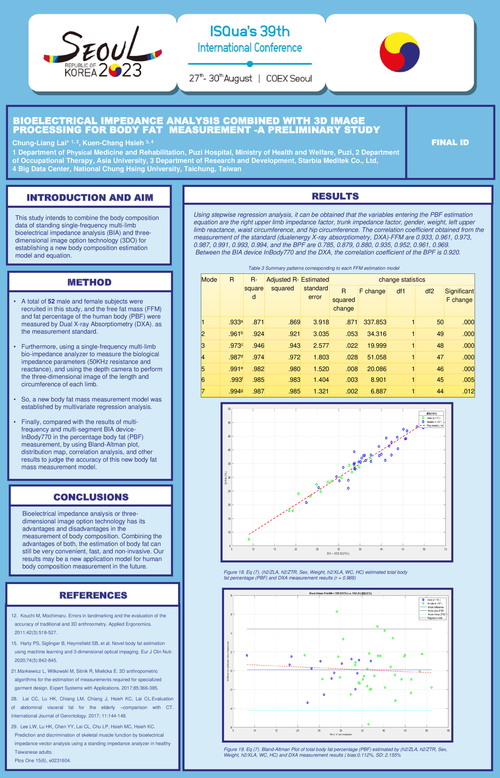
Results: Using stepwise regression analysis, it can be obtained that the variables entering the PBF estimation equation
are the right upper limb impedance factor, trunk impedance factor, gender, weight, left upper limb reactance, waist
circumference, and hip circumference. The correlation coefficient obtained from the measurement of the standard (dualenergy
X-ray absorptiometry, DXA)-FFM are 0.933, 0.961, 0.973, 0.987, 0.991, 0.993, 0.994, and the BPF are 0.785,
0.879, 0.880, 0.935, 0.952, 0.961, 0.969. Between the BIA device InBody770 and the DXA, the correlation coefficient of
the BPF is 0.920.
Conclusion: Bioelectrical impedance analysis or three-dimensional image option technology has its advantages and
disadvantages in the measurement of body composition. Combining the advantages of both, the estimation of body fat
can still be very convenient, fast, and non-invasive. Our results may be a new application model for human body
composition measurement in the future.
Keywords: Bioelectrical impedance analysis, Body composition, Percentage body fat