708 posters, 8 topics, 16 sessions, 1,190 authors, 600 institutions
ePostersLive by SciGen Technologies S.A. All rights reserved.
ISQua's 39th International Conference 2023
August 27 - 30, 2023 | Seoul, Republic of Korea

P017
THE POSSIBLE IMPACT OF ARTIFICIAL INTELLIGENCE ON THE OUTCOME OF VENTILATED PATIENTS IN COVID-19 PANDEMIC
Poster Presenter
Authors
Affiliations
Part of Topic
Digital Healthcare and Innovation
THE POSSIBLE IMPACT OF ARTIFICIAL INTELLIGENCE ON THE OUTCOME OF VENTILATED PATIENTS IN COVID-19 PANDEMIC
Chin-Ming Chen1, 2
Department of Intensive Care Medicine1, Center for Quality Management 2, Chi-Mei Medical Center, Tainan, Taiwan
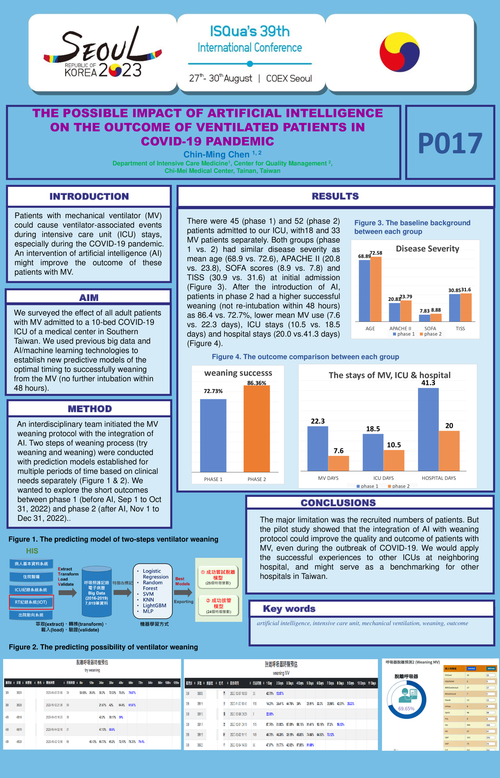
Introduction: Patients with mechanical ventilator (MV) could cause ventilator-associated events during intensive care unit (ICU) stays, especially during the COVID-19 pandemic. An intervention of artificial intelligence (AI) might improve the outcome of these patients with MV.
Methods: We surveyed the effect of all adult patients with MV admitted to a 10-bed COVID-19 ICU of a medical center in Southern Taiwan. We used previous big data and AI/machine learning technologies to establish new predictive models of the optimal timing to successfully weaning from the MV (no further intubation within 48 hours). An interdisciplinary team initiated the MV weaning protocol with the integration of AI. Two steps of weaning process (try weaning and weaning) were conducted with prediction models established for multiple periods of time based on clinical needs separately. We wanted to explore the short outcomes between phase 1 (before AI, Sep 1 to Oct 31, 2022) and phase 2 (after AI, Nov 1 to Dec 31, 2022).
Results: There were 45 (phase 1) and 52 (phase 2) patients admitted to our ICU, with18 and 33 MV patients separately. Both groups (phase 1 vs. 2) had similar disease severity as mean age (68.9 vs. 72.6), APACHE II (20.8 vs. 23.8), SOFA scores (8.9 vs. 7.8) and TISS (30.9 vs. 31.6) at initial admission. After the introduction of AI, patients in phase 2 had a higher successful weaning (not re-intubation within 48 hours) as 86.4 vs. 72.7%, lower mean MV periods (7.6 vs. 22.3 days), ICU stays (10.5 vs. 18.5 days) and hospital stays (20.0 vs.41.3 days).
Conclusions: The major limitation was the recruited numbers of patients. But the pilot study showed that the integration of AI with weaning protocol could improve the quality and outcome of patients with MV, even during the outbreak of COVID-19. We would apply the successful experiences to other ICUs at neighboring hospital, and might serve as a benchmarking for other hospitals in Taiwan.
Key words: artificial intelligence, intensive care unit, mechanical ventilation, weaning, outcome