708 posters, 8 topics, 16 sessions, 1,190 authors, 600 institutions
ePostersLive by SciGen Technologies S.A. All rights reserved.
ISQua's 39th International Conference 2023
August 27 - 30, 2023 | Seoul, Republic of Korea

P016
THE IMPACT OF TECHNOLOGICAL INNOVATION ON ORGANIZATIONAL MANAGEMENT PERFORMANCE - THE INTRODUCTION OF ARTIFICIAL INTELLIGENCE SYSTEMS INTO A MEDICAL INSTITUTION AS AN EXAMPLE
Poster Presenter
Part of Topic
Digital Healthcare and Innovation
THE IMPACT OF TECHNOLOGICAL INNOVATION ON ORGANIZATIONAL MANAGEMENT PERFORMANCE - THE INTRODUCTION OF ARTIFICIAL INTELLIGENCE SYSTEMS INTO A MEDICAL INSTITUTION AS AN EXAMPLE
Ching-Yu Chang* 1, SHEAU-HWA CHEN2
1Medical Affairs Department , Hualien Tzuchi Hospital, 2College of Management, Dong Hwa University, Hualien, Taiwan, Province of China
Introduction: Under the Universal Health Insurance Care System, hospitals are reimbursed by the Health Insurance Department through coding, initially assigned by physicians then verified by disease classifiers, based on the International Classification of Diseases (ICD-10). Should there be any coding discrepancy, the adjusting process will take time and jeopardize a hospital’s cash flow. Whether the process could be improved with the assistance of artificial intelligence (AI) has become a focal interest to most medical institutions in Taiwan.
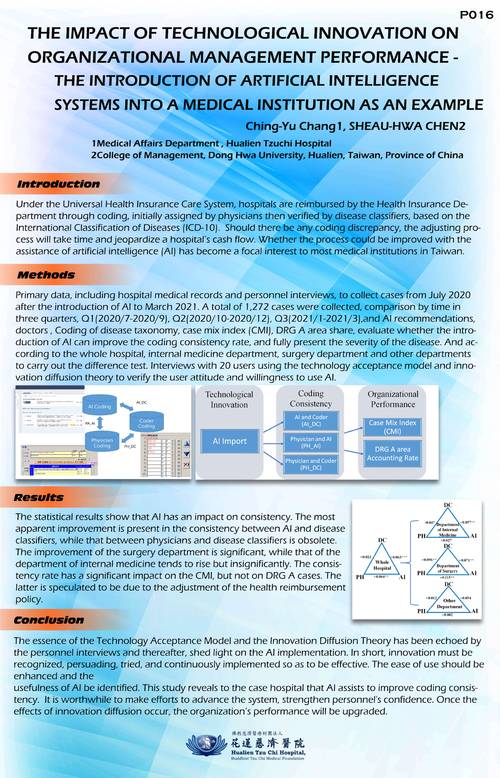
Methods: Primary data, including hospital medical records and personnel interviews, to collect cases from July 2020 after the introduction of AI to March 2021. A total of 1,272 cases were collected, comparison by time in three quarters, Q1(2020/7-2020/9), Q2(2020/10-2020/12), Q3(2021/1-2021/3),and AI recommendations, doctors , Coding of disease taxonomy, case mix index (CMI), DRG A area share, evaluate whether the introduction of AI can improve the coding consistency rate, and fully present the severity of the disease. And according to the whole hospital, internal medicine department, surgery department and other departments to carry out the difference test. Interviews with 20 users using the technology acceptance model and innovation diffusion theory to verify the user attitude and willingness to use AI.
Results: The statistical results show that AI has an impact on consistency. The most apparent improvement is present in the consistency between AI and disease classifiers, while that between physicians and disease classifiers is obsolete. The improvement of the surgery department is significant, while that of the department of internal medicine tends to rise but insignificantly. The consistency rate has a significant impact on the CMI, but not on DRG A cases. The latter is speculated to be due to the adjustment of the health reimbursement policy.
Conclusion: The essence of the Technology Acceptance Model and the Innovation Diffusion Theory has been echoed by the personnel interviews and thereafter, shed light on the AI implementation. In short, innovation must be recognized, persuading, tried, and continuously implemented so as to be effective. The ease of use should be enhanced and the usefulness of AI be identified. This study reveals to the case hospital that AI assists to improve coding consistency. It is worthwhile to make efforts to advance the system, strengthen personnel's confidence. Once the effects of innovation diffusion occur, the organization’s performance will be upgraded.