708 posters, 8 topics, 16 sessions, 1,190 authors, 600 institutions
ePostersLive by SciGen Technologies S.A. All rights reserved.
ISQua's 39th International Conference 2023
August 27 - 30, 2023 | Seoul, Republic of Korea

P007
STREAMLINING RADIATION ONCOLOGY POLICY REVIEW PROCESS USING IMPROVEMENT SCIENCE TOOLS
Poster Presenter
Part of Topic
Digital Healthcare and Innovation
Introduction & Aim:
Policies define the safety, professional and legal standards for all Healthcare institutions. A robust review process must be in place to ensure policies are continuously updated and accurately reflect the current practice and legislation1. This critical activity often takes significant time and resources. This study involved streamlining the policy review process for a large Canadian Radiation Oncology Program using a number of improvement science tools2, to enable resource optimization and value creation for their patients and healthcare teams.
Method:
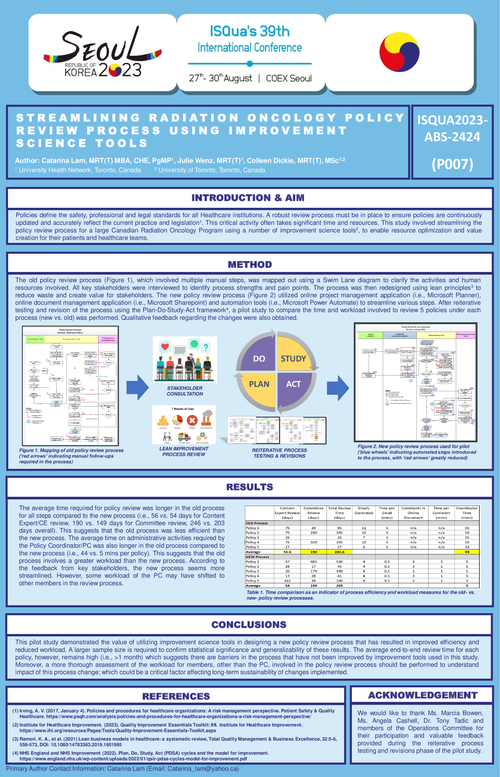
The old policy review process (Figure 1), which involved multiple manual steps, was mapped out using a Swim Lane diagram to clarify the activities and human resources involved. All key stakeholders were interviewed to identify process strengths and pain points. The process was then redesigned using lean principles3 to reduce waste and create value for stakeholders. The new policy review process (Figure 2) utilized online project management application (i.e., Microsoft Planner), online document management application (i.e., Microsoft Sharepoint) and automation tools (i.e., Microsoft Power Automate) to streamline various steps. After reiterative testing and revision of the process using the Plan-Do-Study-Act framework4, a pilot study to compare the time and workload involved to review 5 policies under each process (new vs. old) was performed. Qualitative feedback regarding the changes were also obtained.
Results:
The average time required for policy review was longer in the old process for all steps compared to the new process (i.e., 56 vs. 54 days for Content Expert/CE review, 190 vs. 149 days for Committee review, 246 vs. 203 days overall). This suggests that the old process was less efficient than the new process. The average time on administrative activities required by the Policy Coordinator/PC was also longer in the old process compared to the new process (i.e., 44 vs. 5 mins per policy). This suggests that the old process involves a greater workload than the new process. According to the feedback from key stakeholders, the new process seems more streamlined. However, some workload of the PC may have shifted to other members in the review process.
Conclusions:
This pilot study demonstrated the value of utilizing improvement science tools in designing a new policy review process that has resulted in improved efficiency and reduced workload. A larger sample size is required to confirm statistical significance and generalizability of these results. The average end-to-end review time for each policy, however, remains high (i.e., >1 month) which suggests there are barriers in the process that have not been improved by improvement tools used in this study. Moreover, a more thorough assessment of the workload for members, other than the PC, involved in the policy review process should be performed to understand impact of this process change; which could be a critical factor affecting long-term sustainability of changes implemented.