708 posters, 8 topics, 16 sessions, 1,190 authors, 600 institutions
ePostersLive by SciGen Technologies S.A. All rights reserved.
ISQua's 39th International Conference 2023
August 27 - 30, 2023 | Seoul, Republic of Korea

P006
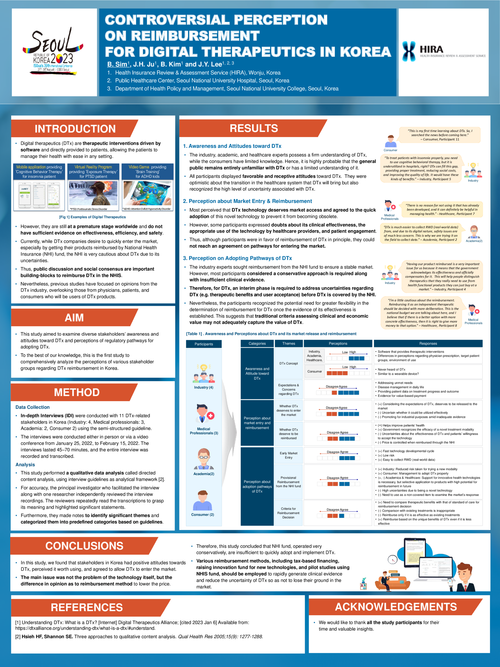
CONTROVERSIAL PERCEPTION ON REIMBURSEMENT FOR DIGITAL THERAPEUTICS IN KOREA
Poster Presenter
Authors
Affiliations
Part of Topic
Digital Healthcare and Innovation
Controversial perception on reimbursement for digital therapeutics in Korea
1. Introduction
- Digital therapeutics (DTx) are therapeutic interventions driven by software and directly provided to patients, allowing the patients to manage their health with ease in any setting.
- However, they are still at a premature stage worldwide and do not have sufficient evidence on effectiveness, efficiency, and safety.
- Currently, while DTx companies desire to quickly enter the market, especially by getting their products reimbursed by National Health Insurance (NHI) fund, the NHI is very cautious about DTx due to its uncertainties.
- Thus, public discussion and social consensus are important building-blocks to reimburse DTx in the NHIS.
- Nevertheless, previous studies have focused on opinions from the DTx industry, overlooking those from physicians, patients, and consumers who will be users of DTx products.
2. AIM
- This study aimed to examine diverse stakeholders’ awareness and attitudes toward DTx and perceptions of regulatory pathways for adopting DTx.
- To the best of our knowledge, this is the first study to comprehensively analyze the perceptions of various stakeholder groups regarding DTx reimbursement in Korea.
3. METHOD
3.1. Data Collection
- In-depth Interviews (IDI) were conducted with 11 DTx-related stakeholders in Korea (Industry: 4, Medical professionals: 3, Academia: 2, Consumer 2) using the semi-structured guideline.
- The interviews were conducted either in person or via a video conference from January 25, 2022, to February 15, 2022. The interviews lasted 45–70 minutes, and the entire interview was recorded and transcribed.
3.2. Analysis
- This study performed a qualitative data analysis called directed content analysis, using interview guidelines as analytical framework [2].
- For accuracy, the principal investigator who facilitated the interview along with one researcher independently reviewed the interview recordings. The reviewers repeatedly read the transcriptions to grasp its meaning and highlighted significant statements.
- Furthermore, they made notes to identify significant themes and categorized them into predefined categories based on guidelines.
4. RESULTS
4.1. Awareness and Attitudes toward DTx
- The industry, academic, and healthcare experts possess a firm understanding of DTx, while the consumers have limited knowledge. Hence, it is highly probable that the general public remains entirely unfamiliar with DTx or has a limited understanding of it.
- All participants displayed favorable and receptive attitudes toward DTx. They were optimistic about the transition in the healthcare system that DTx will bring but also recognized the high level of uncertainty associated with DTx.
4.2. Perception about Market Entry & Reimbursement
- Most perceived that DTx technology deserves market access and agreed to the quick adoption of this novel technology to prevent it from becoming obsolete.
- However, some participants expressed doubts about its clinical effectiveness, the appropriate use of the technology by healthcare providers, and patient engagement.
- Thus, although participants were in favor of reimbursement of DTx in principle, they could not reach an agreement on pathways for entering the market.
4.3. Perception on Adopting Pathways of DTx
- The industry experts sought reimbursement from the NHI fund to ensure a stable market. However, most participants considered a conservative approach is required along with insufficient clinical evidence.
- Therefore, for DTx, an interim phase is required to address uncertainties regarding DTx (e.g. therapeutic benefits and user acceptance) before DTx is covered by the NHI.
- Nevertheless, the participants recognized the potential need for greater flexibility in the determination of reimbursement for DTx once the evidence of its effectiveness is established. This suggests that traditional criteria assessing clinical and economic value may not adequately capture the value of DTx.
5. CONCLUSIONS
- In this study, we found that stakeholders in Korea had positive attitudes towards DTx, perceived it worth using, and agreed to allow DTx to enter the market.
- The main issue was not the problem of the technology itself, but the difference in opinion as to reimbursement method to lower the price.
- Therefore, this study concluded that NHI fund, operated very conservatively, are insufficient to quickly adopt and implement DTx.
- Various reimbursement methods, including tax-based financing, raising innovation fund for new technologies, and pilot studies using NHIS fund, should be employed to rapidly generate clinical evidence and reduce the uncertainty of DTx so as not to lose their ground in the market.