708 posters, 8 topics, 16 sessions, 1,190 authors, 600 institutions
ePostersLive by SciGen Technologies S.A. All rights reserved.
ISQua's 39th International Conference 2023
August 27 - 30, 2023 | Seoul, Republic of Korea

ISQUA2023-ABS-3127
INCREASING CLIENTS ACCESS TO ANTIRETROVIRAL MEDICATION FOR PEOPLE LIVING WITH HIV – EARLY LESSONS ON THE IMPLEMENTATION OF THE AUTOMATED MEDICATION DISPENSING SYSTEM IN ESWATINI
Poster Presenter
Authors
Samson HAUMBA, Victor Williams, Fikile Ngwenya-Ngcamphalala, Arnold Mafukidze, Normusa Musarapasi, Hugben Byarugaba, Pido Bongomin, Fortunate Bhembe, Sylvia Ojoo, Velephi Okello, Deus Bazira
Affiliations
Center for Global Health Practice and Impact, Georgetown University, Mbabane, Eswatini., Eswatini Ministry of Health, Mbabane, Eswatini, Center for Global Health Practice and Impact, Georgetown University
Part of Topic
Digital Healthcare and Innovation
ISQUA2023.07300D1
INCREASING CLIENTS ACCESS TO ANTIRETROVIRAL MEDICATION FOR PEOPLE LIVING WITH HIV – EARLY LESSONS ON THE IMPLEMENTATION OF THE AUTOMATED MEDICATION DISPENSING SYSTEM IN ESWATINI
S. HAUMBA1, V. Williams1,F. Ngwenya-Ngcamphalala1, A. Mafukidze1, N. Musarapasi1, H. Byarugaba1, P. Bongomin1, F. Bhembe2, S. Ojoo1, V. Okello2, D. Bazira1
1. Center for Global Health Practice and Impact, Georgetown University 2. Eswatini Ministry of Health, Mbabane, Eswatini.
Introduction
- With more than 200, 000 people living with HIV, the prevalence of HIV in Eswatini is high at 24.8% in adults aged 15 years and above with an overall incidence of 1.4%.
- Nonetheless, Eswatini is one of two countries to achieve the UNAIDS 95-95-95 HIV targets.
- Sustaining the above gains and ensuring access to HIV treatment services for marginalized and vulnerable at-risk populations requires innovative approaches to service delivery.
- With PEPFAR funding through the CDC, Georgetown University, working with the Eswatini Ministry of Health and other stakeholders, collaboratively adapted and installed an Automated Medication Dispensing system (AMDS), in five health facilities.
- We share lessons from the implementation of an automated medication dispensing system (AMDS), called LulaMeds TM
Method
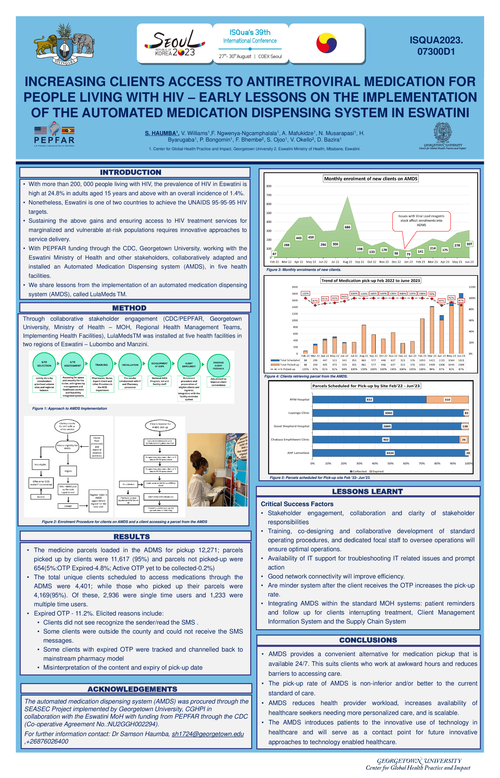
Through collaborative stakeholder engagement (CDC/PEPFAR, Georgetown University, Ministry of Health – MOH, Regional Health Management Teams, Implementing Health Facilities), LulaMedsTM was installed at five health facilities in two regions of Eswatini – Lubombo and Manzini.
Results
- The medicine parcels loaded in the ADMS for pickup 12, 271; parcels picked up by clients were 11,617 (95%) and parcels not picked-up were 654(5%:OTP Expired-4.8%; Active OTP yet to be collected-0.2%)
- The total unique clients scheduled to access medications through the ADMS were 4,401; while those who picked up their parcels were 4,169(95%). Of these, 2,936 were single-time users and 1,233 were multiple-time users.
- Expired OTP - 11.2%. Elicited reasons include:
- Clients did not see or recognize the sender/read the SMS.
- Some clients were outside the county and could not receive SMS messages.
- Some clients with expired OTP were tracked and channelled back to the mainstream pharmacy model
- Misinterpretation of the content and expiry of the pick-up date
Lessons Learnt
Critical Success Factors
- Stakeholder engagement, collaboration and clarity of stakeholder responsibilities
- Training, co-designing and collaborative development of standard operating procedures, and dedicated focal staff to oversee operations will ensure optimal operations.
- Availability of IT support for troubleshooting IT-related issues and prompt action
- Good network connectivity will improve efficiency.
- Are minder system after the client receives the OTP increases the pick-up rate.
- Integrating AMDS within the standard MOH systems: patient reminders and follow-up for clients interrupting treatment, Client Management Information System and the Supply Chain System
Conclusion
- AMDS provides a convenient alternative for medication pickup that is available 24/7. This suits clients who work at awkward hours and reduces barriers to accessing care.
- The pick-up rate of AMDS is non-inferior and/or better than the current standard of care.
- AMDS reduces health provider workload, increases the availability of healthcare seekers needing more personalized care, and is scalable.
- The AMDS introduces patients to the innovative use of technology in healthcare and will serve as a contact point for future innovative approaches to technology-enabled healthcare.