708 posters, 8 topics, 16 sessions, 1,190 authors, 600 institutions
ePostersLive by SciGen Technologies S.A. All rights reserved.
ISQua's 39th International Conference 2023
August 27 - 30, 2023 | Seoul, Republic of Korea

ISQUA2023-ABS-1490
A FRAMEWORK FOR THE BUILT ENVIRONMENT SUPPORTIVE OF RESILIENT PERFORMANCE IN THE CONNECTING AREAS OF AN INTENSIVE CARE UNIT
Poster Presenter
Part of Topic
Patient Safety & Quality Improvement
A Framework for the Built Environment supportive of Resilient Performance in the Connecting Areas of an Intensive Care Unit
Natália Ransolin¹,³, Tarcísio Abreu Saurin², Robyn Clay-Williams³, Carlos Torres Formoso¹, Frances Rapport³
¹ Postgraduate Program in Civil Engineering: Construction and Infrastructure (PPGCI), Federal Universityof Rio Grande do Sul (UFRGS), Porto Alegre, Brazil
² Industrial Engineering and Transportation Department (DEPROT), UFRGS, Porto Alegre, Brazil
³ Australian Institute of Health Innovation (AIHI), Macquarie University, Sydney, Australia
Introduction
Resilient performance is an emergent property arising from the dynamic interactions between diverse technical, social, and organizational elements of complex systems [1]. Health services have long been acknowledged as complex systems that display resilience to cope with both expected and unexpected conditions while maintaining the delivery of the required outputs [2], [3]. The built environment is a key technical element of most health services, as it has a strong impact in the service efficiency, safety, and resilience [4]. In particular, connecting areas of Intensive Care Units (c-ICU areas) are workspaces where internal hospital logistics and care delivery take place, supporting or hindering the resilient performance of staff to trade-off between safety and efficiency pressures.
Method
The development of the knowledge was based on a case study in a large teaching hospital in Southern Brazil. Data collection techniques adopted were semi-structured interviews (38 interviewees), observations and walkthroughs (32 visits), and document analysis [5]. Also, a meeting with hospital staff was undertaken to receive feedback on the findings. Data were analysed based on thematic analysis with themes corresponding to the seven design principles for resilient performance from Ransolin et al. (2022) [6]. The internal logistics functions were modelled using Functional Resonance Analysis Method (FRAM), linking the design prescriptions to the precondition aspects of FRAM functions.
Objective
This study aimed to develop a framework to present the BEdesign knowledge for resilient performance for internal hospital logistics in the c-ICU areas.
Results
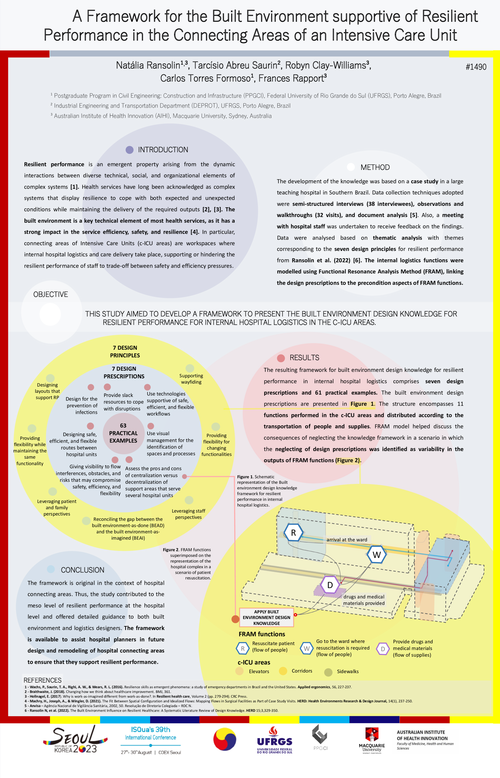
The resulting framework for built environment design knowledge for resilient performance in internal hospital logistics comprises seven design prescriptions and 61 practical examples. The built environment design prescriptions are presented in Figure 1. The structure encompasses 11 functions performed in the c-ICU areas and distributed according to the transportation of people and supplies. FRAM model helped discuss the consequences of neglecting the knowledge framework in a scenario in which the neglecting of design prescriptions was identified as variability in the outputs of FRAM functions (Figure 2).
Conclusion
The framework is original in the context of hospital connecting areas. Thus, the study contributed to the meso level of resilient performance at the hospital level and offered detailed guidance to both built environment and logistics designers. The framework is available to assist hospital planners in future design and remodeling of hospital connecting areas to ensure that they support resilient performance.
References
1 - Wachs, P., Saurin, T. A., Righi, A. W., & Wears, R. L. (2016). Resilience skills as emergent phenomena: a study of emergency departments in Brazil and the United States. Applied ergonomics, 56, 227-237.
2 - Braithwaite, J. (2018). Changing how we think about healthcare improvement. BMJ, 361.
3 - Hollnagel, E. (2017). Why is work-as-imagined different from work-as-done?. In Resilient health care, Volume 2 (pp. 279-294). CRC Press.
4 - Machry, H., Joseph, A., & Wingler, D. (2021). The Fit Between Spatial Configuration and Idealized Flows: Mapping Flows in Surgical Facilities as Part of Case Study Visits. HERD: Health Environments Research & Design Journal, 14(1), 237-250.
5 - Anvisa– Agência Nacional de VigilânciaSanitária, 2002, 50. Resolução de DiretoriaColegiada – RDC N.
6 - Ransolin N, et al. (2022). The Built Environment Influence on Resilient Healthcare: A Systematic Literature Review of Design Knowledge. HERD 15;3,329-350.