708 posters, 8 topics, 16 sessions, 1,190 authors, 600 institutions
ePostersLive by SciGen Technologies S.A. All rights reserved.
ISQua's 39th International Conference 2023
August 27 - 30, 2023 | Seoul, Republic of Korea

ISQUA2023-ABS-1874
EXPLORING THE PRIMARY CAREGIVER’S EXPERIENCES IN RECOGNISING AND RESPONDING CLINICAL DETERIORATION IN EMERGENCY PATIENTS: A QUALITATIVE STUDY
Poster Presenter
Authors
Affiliations
Part of Topic
Patient Safety & Quality Improvement
Exploring the primary caregiver’s experiences in recognising and responding to clinical deterioration in emergency patients: A qualitative study
Introduction: The role of the relatives of patients is increasingly being valued internationally in acute clinical deterioration events. They have the closest contact with patients, sometimes even stay beside the bed 24 hours a day as primary family caregivers, and may be the first to sense them with something wrong and struggle to respond. However, only a few studies have sought to explore the primary caregivers’ experiences in recognising and responding to patient deterioration.
Aim: This study aimed to explore the perceptions and experiences of primary family caregivers in identifying and responding to patient deterioration in the emergency department.
Method: A descriptive qualitative study using individual semi-structured interviews was conducted in an emergency department of the 3000-bed tertiary general hospital. This hospital adhered to the management approach of “one patient can only have one family caregiver” in the prevention and control of the novel coronavirus. Purposive sampling was used to recruit a total of 14 primary family caregivers of emergency patients who cared over 5 days a week and over 5 hours a day. They can communicate changes of patients’ conditions with clinicians and activate the escalation care. The concurrent data collection and content analysis aimed to identify the thematic saturation.
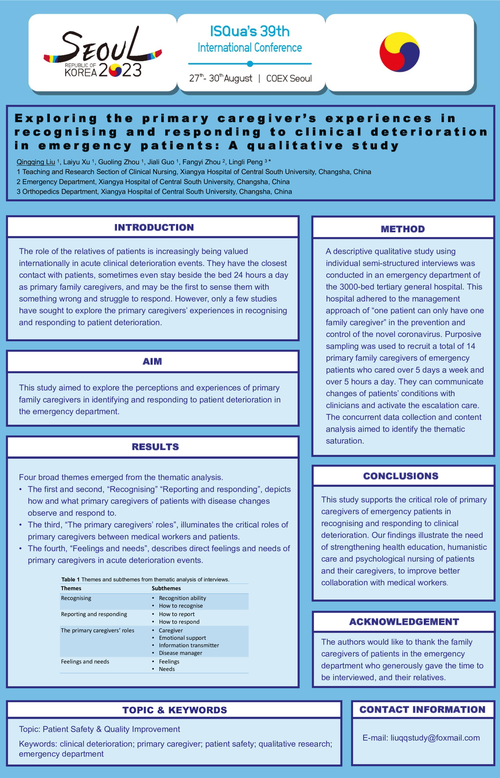
Results: Four broad themes emerged from the thematic analysis. The first and second, “Recognising” “Reporting and responding”, depicts how and what primary caregivers of patients with disease changes observe and respond to. The third, “The primary caregivers’ roles”, illuminates the critical roles of primary caregivers between medical workers and patients. The fourth, “Feelings and needs”, describes direct feelings and needs of primary caregivers in acute deterioration events.
Conclusions: This study supports the critical role of primary caregivers of emergency patients in recognising and responding to clinical deterioration. Our findings illustrate the need of strengthening health education, humanistic care and psychological nursing of patients and their caregivers, to improve better collaboration with medical workers.