708 posters, 8 topics, 16 sessions, 1,190 authors, 600 institutions
ePostersLive by SciGen Technologies S.A. All rights reserved.
ISQua's 39th International Conference 2023
August 27 - 30, 2023 | Seoul, Republic of Korea

ISQUA2023-ABS-2160
IMPROVING PATIENT SAFETY THROUGH LEARNING FROM SUCCESSES AND FAILURES: QUALITATIVE SURVEYS AND INTERVIEWS WITH INTERNATIONAL EXPERTS.
Poster Presenter
Authors
Affiliations
Part of Topic
Patient Safety & Quality Improvement
Improving patient safety through learning from successes and failures: Qualitative surveys and interviews with international experts
Peter Hibbert1 2, Sasha Stewart1, Matthew Thomas 3, Louise Wiles1 2, William Runciman2
1 Australian Institute of Health Innovation, Macquarie University, Australia
2 IIMPACT in Health, Allied Health and Human Performance, University of South Australia
What is the problem?: Patient harm is a leading cause of global disease burden with considerable morbidity, mortality and economic impacts for individuals, their families and wider society. A large body of evidence exists for strategies to improve safety and reduce harm. However, it is not currently clear which patient safety issues are being addressed globally, and which factors are the most (or least) important contributors to improvements in patient safety.
Therefore, we aimed to survey international patient safety experts to: (1) identify the nature and range of patient safety issues being addressed globally, and (2) explore their perspectives on aspects of patient safety governance and systems that are perceived to provide value or are not effective in improving outcomes for patients.
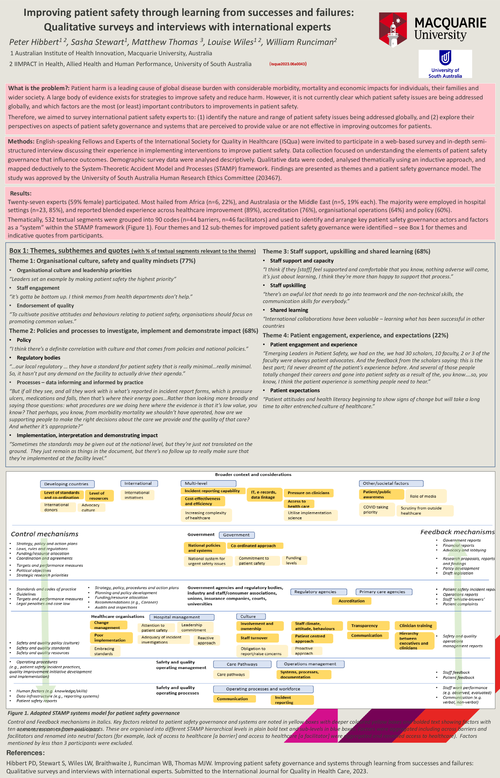
Methods: English-speaking Fellows and Experts of the International Society for Quality in Healthcare (ISQua) were invited to participate in a web-based survey and in-depth semi-structured interview discussing their experience in implementing interventions to improve patient safety. Data collection focused on understanding the elements of patient safety governance that influence outcomes. Demographic survey data were analysed descriptively. Qualitative data were coded, analysed thematically using an inductive approach, and mapped deductively to the System-Theoretic Accident Model and Processes (STAMP) framework. Findings are presented as themes and a patient safety governance model. The study was approved by the University of South Australia Human Research Ethics Committee (203467).
Results:
Twenty-seven experts (59% female) participated. Most hailed from Africa (n=6, 22%), and Australasia or the Middle East (n=5, 19% each). The majority were employed in hospital settings (n=23, 85%), and reported blended experience across healthcare improvement (89%), accreditation (76%), organisational operations (64%) and policy (60%).
Thematically, 532 textual segments were grouped into 90 codes (n=44 barriers, n=46 facilitators) and used to identify and arrange key patient safety governance actors and factors as a “system” within the STAMP framework (Figure 1). Four themes and 12 sub-themes for improved patient safety governance were identified – see Box 1 for themes and indicative quotes from participants.
References:
Hibbert PD, Stewart S, Wiles LW, Braithwaite J, Runciman WB, Thomas MJW. Improving patient safety governance and systems through learning from successes and failures: Qualitative surveys and interviews with international experts. Submitted to the International Journal for Quality in Health Care, 2023.