301 posters, 50 videos, 13 topics, 13 sessions, 734 authors, 193 institutions
ePostersLive by SciGen Technologies S.A. All rights reserved.
ISMICS 2026 Annual Meeting
10 - 13 June, 2026 | Miami, Florida

P94
Peri-areolar Approach For Minimally Invasive Septal Defect Repair : Early Experience
Poster Presenter
Part of Topic
Pediatric - Cardiac, Cardiovascular & Thoracic
Peri-Areolar Approach For Minimally Invasive Septal Defect Repair: Early Experience
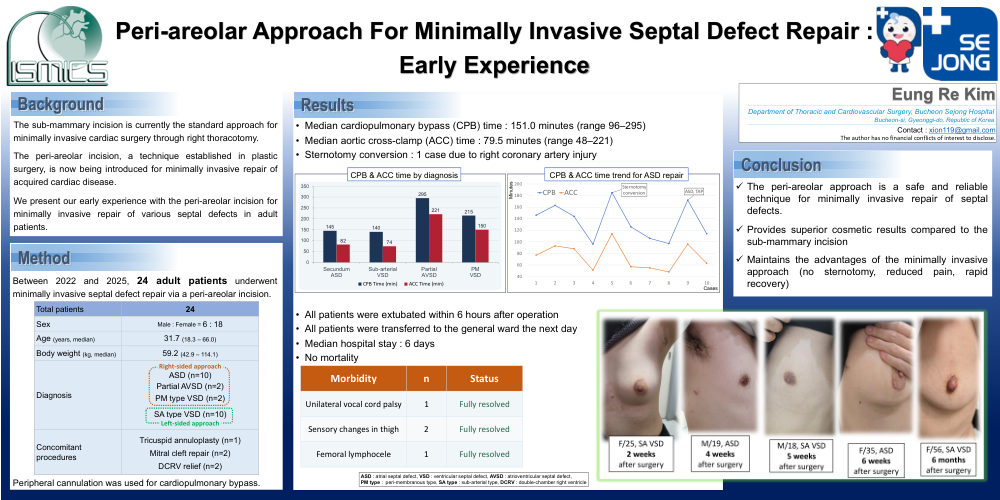
BACKGROUND - Minimally invasive cardiac surgery is increasingly utilized, with the sub-mammary incision currently serving as the standard approach for right thoracotomy. The peri-areolar incision, a technique established in plastic surgery, is now being introduced for minimally invasive repair of acquired cardiac disease. We present our early experience with the peri-areolar incision for minimally invasive repair of various septal defects in adult patients.
METHODS - Between 2022 and 2025, 24 adult patients underwent minimally invasive septal defect repair via a peri-areolar incision. The median age was 31.7 years (range 18.3–66), and the median body weight was 59.2 kg (range 42.9–114.1). Diagnoses included secundum atrial septal defect (n=10), partial atrioventricular septal defect (n=2), perimembranous ventricular septal defect (VSD) (n=2), and supracristal VSD (n=10). Combined procedures comprised tricuspid annuloplasty (n=1), cleft closure (n=2), and double-chamber right ventricle (DCRV) relief (n=2). Most procedures were performed from the right side, whereas supracristal VSDs were repaired through a left peri-areolar incision. Peripheral cannulation was used for cardiopulmonary bypass.
RESULTS - The median cardiopulmonary bypass (CPB) time was 151.0 minutes (range 96–295), and the median aortic cross-clamp time was 79.5 minutes (range 48–221). One conversion to sternotomy occurred due to right coronary injury. The median hospital stay was 6 days. Complications included unilateral vocal cord palsy (n=1), sensory changes in the thigh (n=2), and femoral lymphocele (n=1); all complications resolved during follow-up. Follow-up assessments indicated excellent cosmetic outcomes.
CONCLUSIONS - The peri-areolar approach is a safe and reliable technique for minimally invasive repair of septal defects. This is superior in cosmetic results compared to the sub-mammary incision while maintaining the advantages of a minimally invasive approach, such as reduced pain and rapid recovery. The approach may be further expanded to include other procedures, such as partial anomalous pulmonary venous connection repair, mitral or tricuspid valve interventions, and right ventricular outflow tract procedures.