301 posters, 50 videos, 13 topics, 13 sessions, 739 authors, 192 institutions
ePostersLive by SciGen Technologies S.A. All rights reserved.
ISMICS 2026 Annual Meeting
10 - 13 June, 2026 | Miami, Florida

D156
Aneurysm Of The Right Atrial Auricle In An Adult
Poster Presenter
Authors
Part of Topic
Pediatric - Cardiac, Cardiovascular & Thoracic
Video
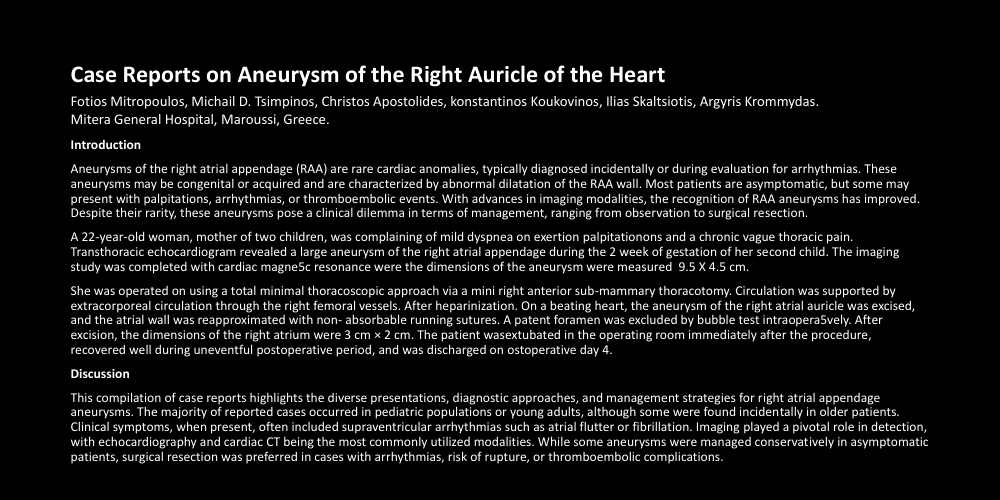
Case Reports on Aneurysm of the Right Auricle of the Heart
Introduction
Aneurysms of the right atrial appendage (RAA) are rare cardiac anomalies, typically diagnosed incidentally or during evaluation for arrhythmias. These aneurysms may be congenital or acquired and are characterized by abnormal dilatation of the RAA wall. Most patients are asymptomatic, but some may present with palpitations, arrhythmias, or thromboembolic events. With advances in imaging modalities, the recognition of RAA aneurysms has improved. Despite their rarity, these aneurysms pose a clinical dilemma in terms of management, ranging from observation to surgical resection.
A 22-year-old woman, mother of two children, was complaining of mild dyspnea on exertion palpitationons and a chronic vague thoracic pain. Transthoracic echocardiogram revealed a large aneurysm of the right atrial appendage during the 2 week of gestation of her second child. The imaging study was completed with cardiac magne5c resonance were the dimensions of the aneurysm were measured 9.5 X 4.5 cm.
She was operated on using a total minimal thoracoscopic approach via a mini right anterior sub-mammary thoracotomy. Circulation was supported by extracorporeal circulation through the right femoral vessels. After heparinization. On a beating heart, the aneurysm of the right atrial auricle was excised, and the atrial wall was reapproximated with non- absorbable running sutures. A patent foramen was excluded by bubble test intraopera5vely. After excision, the dimensions of the right atrium were 3 cm × 2 cm. The patient was
extubated in the operating room immediately after the procedure, recovered well during uneventful postoperative period, and was discharged on postoperative day 4.
Discussion
This compilation of case reports highlights the diverse presentations, diagnostic approaches, and management strategies for right atrial appendage aneurysms. The majority of reported cases occurred in pediatric populations or young adults, although some were found incidentally in older patients. Clinical symptoms, when present, often included supraventricular arrhythmias such as atrial flutter or fibrillation. Imaging played a pivotal role in detection, with echocardiography and cardiac CT being the most commonly utilized modalities. While some aneurysms were managed conservatively in asymptomatic patients, surgical resection was preferred in cases with arrhythmias, risk of rupture, or thromboembolic complications.