301 posters, 50 videos, 13 topics, 13 sessions, 734 authors, 193 institutions
ePostersLive by SciGen Technologies S.A. All rights reserved.
ISMICS 2026 Annual Meeting
10 - 13 June, 2026 | Miami, Florida

P5
Is Minimally Invasive Approach Better Than Full Sternotomy In Acute Type A Aortic Dissection?
Part of Topic
Aortic and Endovascular Therapies
Is minimally invasive approach better than full sternotomy in acute type A aortic dissection?
Objectives
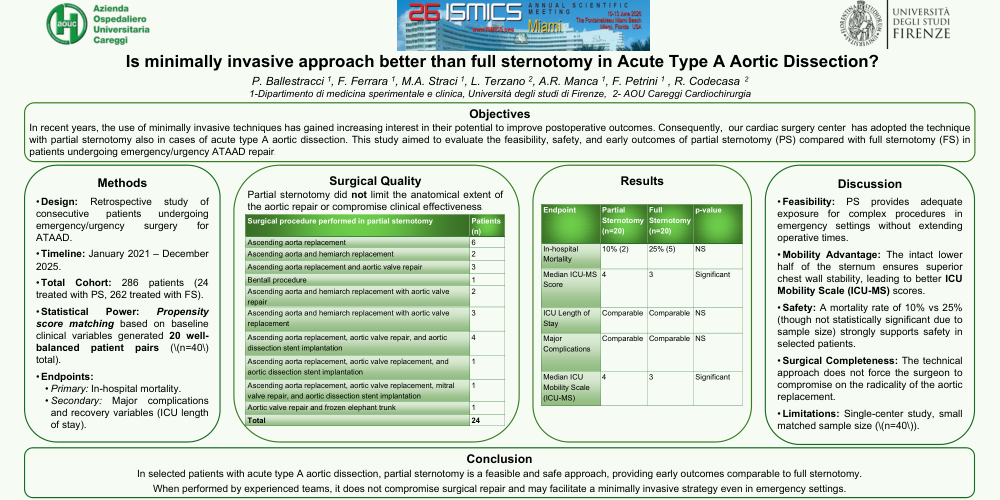
In recent years, the use of minimally invasive techniques has gained increasing interest in their potential to improve postoperative outcomes. Consequently, our cardiac surgery center has adopted the technique with partial sternotomy also in cases of acute type A aortic dissection. This study aimed to evaluate the feasibility, safety, and early outcomes of partial sternotomy (PS) compared with full sternotomy (FS) in patients undergoing emergency/urgency ATAAD repair.
Methods
We retrospectively analyzed all consecutive patients who underwent emergency/urgency surgery for ATAAD. Patients were classified according to the planned surgical access: PS or FS. Between January 2020 and December 2025, 286 patients underwent ATAAD repair, including 24 treated with partial sternotomy and 262 with full sternotomy. After propensity score matching, 20 well-balanced patient pairs were analyzed. Preoperative, intraoperative, and postoperative data were collected. To reduce selection bias, a propensity score matching analysis was performed using baseline clinical variables at admission. The primary endpoint was evaluation of in-hospital mortality. Secondary endpoints included major postoperative complications and recovery variables, including intensive care unit (ICU) length of stay (LOS).
Results
In-hospital mortality was 10% (2/20) in the PS group and 25% (5/20) in the FS group, without statistically significant difference. No statistical significance difference was found in ICU length of stay. Major postoperative complications were comparable between groups. Notably, a significant improvement in ICU Mobility Scale scores was observed in the PS group (median ICU-MS 4 vs. 3 in the FS group). Importantly, partial sternotomy did not limit the extent of aortic repair nor compromise surgical effectiveness (see Table 1 for details of procedures performed in the PS group).
Conclusion
In selected patients with acute type A aortic dissection, partial sternotomy is a feasible and safe approach, providing early outcomes comparable to full sternotomy. When performed by experienced teams, it does not compromise surgical repair and may facilitate a minimally invasive strategy even in emergency settings.