301 posters, 50 videos, 13 topics, 13 sessions, 739 authors, 192 institutions
ePostersLive by SciGen Technologies S.A. All rights reserved.
ISMICS 2026 Annual Meeting
10 - 13 June, 2026 | Miami, Florida

D165
Frozen Elephant Trunk For Acute Type A Aortic Dissection Using J-shaped Upper Mini-sternotomy
Poster Presenter
Authors
Rustam Yarbekov, Ulugbek Akhmedov, Khusan Khalikulov, Nasrullo Nishonov, Yorkin Djalilov, Oybek Ilkhomov, Khondamir Mirzaev
Affiliations
Republican specialized scientific and practical medical center of surgery named after academician V. Vakhidov, Republican specialized scientific and practical medical center of surgery named after academician V. Vakhidov/Tashkent State Medical University, Privat Clinic "American Hospital"
Part of Topic
Aortic and Endovascular Therapies
Video
Frozen Elephant Trunk for Acute Type A Aortic Dissection Using J-shaped Upper Mini-sternotomy
Objective
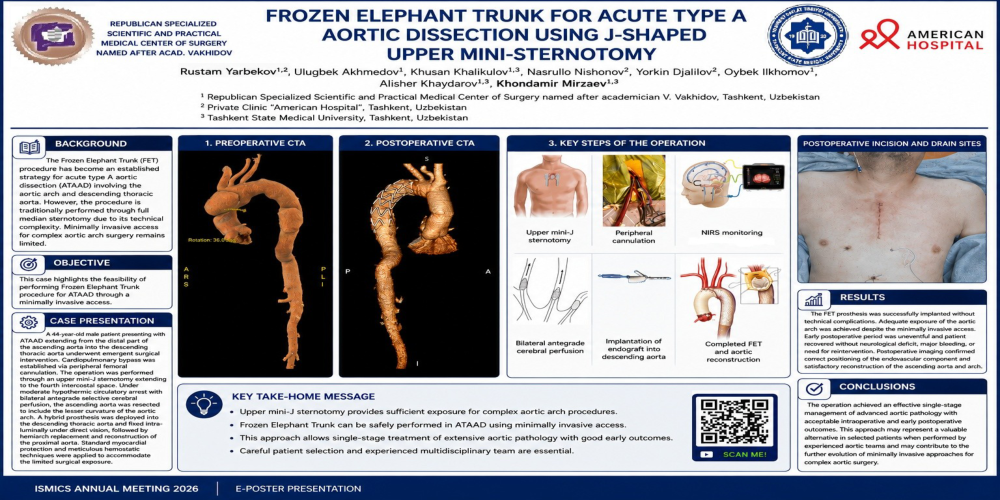
The Frozen Elephant Trunk (FET) procedure has become an established strategy for acute type A aortic dissection (ATAAD) involving the aortic arch and descending thoracic aorta. However, the procedure is traditionally performed through full median sternotomy due to its technical complexity. Minimally invasive access for complex aortic arch surgery remains limited. We present a case of simultaneous hemiarch replacement with endovascular descending aortic repair using the frozen elephant trunk technique performed through an upper mini-J sternotomy.
Methods
A 44-year-old male patient presenting with ATAAD extending from the distal part of the ascending aorta into the descending thoracic aorta underwent emergent surgical intervention. Cardiopulmonary bypass was established via peripheric femoral cannulation. The operation was performed through an upper mini-J sternotomy extending to the fourth intercostal space. Under moderate hypothermic circulatory arrest with bilateral antegrade selective cerebral perfusion, the ascending aorta was resected to include the lesser curvature of the aortic arch. A hybrid prosthesis was deployed into the descending thoracic aorta and fixed intra-luminally under direct vision, followed by hemiarch replacement and reconstruction of the proximal aorta. Standard myocardial protection and meticulous hemostatic techniques were applied to accommodate the limited surgical exposure.
Results
The FET prosthesis was successfully implanted without technical complications. Adequate exposure of the aortic arch was achieved despite the minimally invasive access. Early postoperative period was uneventful and patient recovered without neurological deficit, major bleeding, or need for reintervention. Postoperative imaging confirmed correct positioning of the endovascular component and satisfactory reconstruction of the ascending aorta and arch.
Conclusions
This case highlights the feasibility of performing Frozen Elephant Trunk procedure for ATAAD through a minimally invasive access. The operation achieved an effective single-stage management of advanced aortic pathology with acceptable intraoperative and early postoperative outcomes. This approach may represent a valuable alternative in selected patients when performed by experienced aortic teams and may contribute to the further evolution of minimally invasive approaches for complex aortic surgery.