301 posters, 50 videos, 13 topics, 13 sessions, 734 authors, 193 institutions
ePostersLive by SciGen Technologies S.A. All rights reserved.
ISMICS 2026 Annual Meeting
10 - 13 June, 2026 | Miami, Florida

P42
Short-term Outcomes Of 200 Cases Of Robotic-assisted Minimally Invasive Coronary Artery Bypass Grafting (mics Cabg)
Poster Presenter
Authors
Affiliations
Part of Topic
Coronary Revascularization
Short-term Outcomes of 200 Cases of Robotic-Assisted Minimally Invasive Coronary Artery Bypass Grafting
Sheng Wang Department of Minimally Invasive Cardiac Surgery, Fuwai Central China Cardiovascular Hospital, China Contact information: munich2017-2018@hotmail.com
Background :Robotic-assisted minimally invasive coronary artery bypass grafting (MICS CABG) has emerged as a promising alternative to conventional sternotomy CABG, offering advantages such as reduced surgical trauma, less postoperative pain, shorter hospital stay, and improved cosmetic outcomes. This study aims to summarize the short-term outcomes of 200 consecutive cases of robotic-assisted MICS CABG performed in Fuwai Central China Hospital.
Methods:A retrospective analysis was conducted on 200 patients who underwent robotic-assisted MICS CABG between 1 February,2024 to 30 November,2025 in my hospital,all of cases were done by one surgeon and same team.
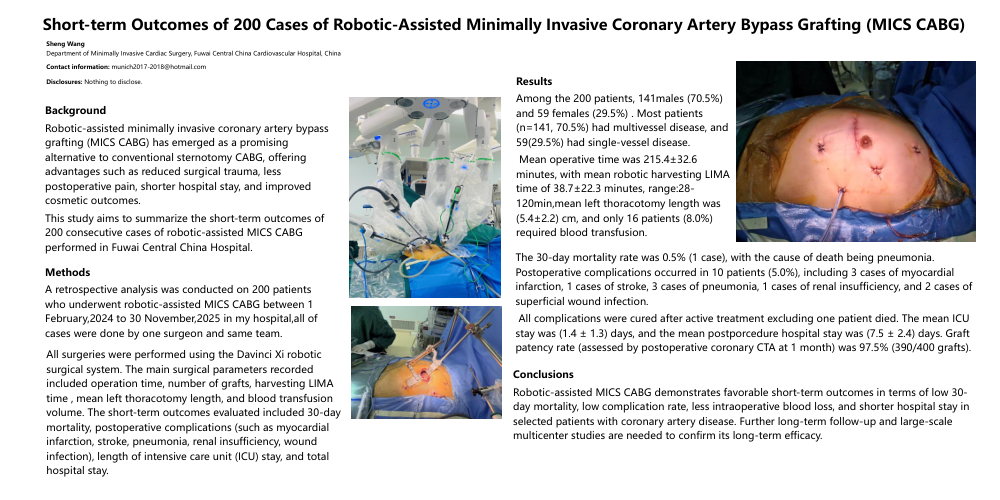
All surgeries were performed using the Davinci Xi robotic surgical system. The main surgical parameters recorded included operation time, number of grafts, harvesting LIMA time , mean left thoracotomy length, and blood transfusion volume. The short-term outcomes evaluated included 30-day mortality, postoperative complications (such as myocardial infarction, stroke, pneumonia, renal insufficiency, wound infection), length of intensive care unit (ICU) stay, and total hospital stay.
Results: Among the 200 patients, 141males (70.5%) and 59 females (29.5%) . Most patients (n=141, 70.5%) had multivessel disease, and 59(29.5%) had single-vessel disease. Mean operative time was 215.4±32.6 minutes, with mean robotic harvesting LIMA time of 38.7±22.3 minutes, range:28-120min,mean left thoracotomy length was (5.4±2.2) cm, and only 16 patients (8.0%) required blood transfusion.
The 30-day mortality rate was 0.5% (1 case), with the cause of death being pneumonia. Postoperative complications occurred in 10 patients (5.0%), including 3 cases of myocardial infarction, 1 cases of stroke, 3 cases of pneumonia, 1 cases of renal insufficiency, and 2 cases of superficial wound infection. All complications were cured after active treatment excluding one patient died. The mean ICU stay was (1.4 ± 1.3) days, and the mean postporcedure hospital stay was (7.5 ± 2.4) days. Graft patency rate (assessed by postoperative coronary CTA at 1 month) was 97.5% (390/400 grafts).
Conclusions :Robotic-assisted MICS CABG demonstrates favorable short-term outcomes in terms of low 30-day mortality, low complication rate, less intraoperative blood loss, and shorter hospital stay in selected patients with coronary artery disease. Further long-term follow-up and large-scale multicenter studies are needed to confirm its long-term efficacy.