301 posters, 50 videos, 13 topics, 13 sessions, 739 authors, 192 institutions
ePostersLive by SciGen Technologies S.A. All rights reserved.
ISMICS 2026 Annual Meeting
10 - 13 June, 2026 | Miami, Florida

D115
Redo Midcab: Tailoring Surgical Approach And Conduit Configuration Based On Target Vessel
Part of Topic
Coronary Revascularization
Objective: Redo coronary artery bypass grafting (CABG) remains one of the most challenging coronary operations, primarily due to the need for repeat sternotomy, dense mediastinal adhesions, and the risk of injury to patent grafts. Advances in minimally invasive coronary surgery (MICS) may offer a compelling alternative; however, data regarding minimally invasive coronary reoperations is scarce. We report our early experience with off-pump redo minimally invasive direct coronary artery bypass grafting (MIDCAB), evaluating its potential role as a modern paradigm within a dedicated coronary revascularization program.
Methods: The study involves a retrospective review of consecutive patients undergoing redo MIDCAB procedures between January 2022 and December 2025. All procedures were performed through a small thoracotomy approach without cardiopulmonary bypass. Patient demographics, preoperative parameters, operative details, graft strategy, and postoperative outcomes were recorded prospectively in a computerized database. Primary endpoints were in-hospital mortality and major adverse cardiac/cerebrovascular events. Secondary endpoints included conversion to sternotomy, transfusion requirements, ventilation time, and intensive care unit (ICU), and hospital stay.
Results: The case series includes 8 male patients (mean age 68 ± 10 years) who underwent minimally invasive redo MIDCAB (5 elective, 3 urgent). PCI option was exhausted in all patients. Of these, 3 patients had unstable angina, 1 non-ST-elevation myocardial infarction and 4 chronic stable angina. Five patients were diabetic. All patients required revascularization of only one target vessel.
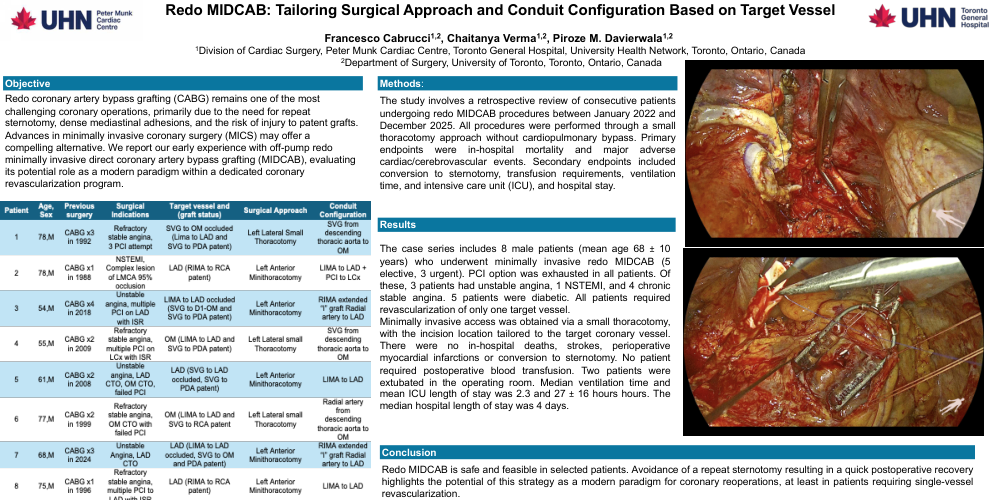
Minimally invasive access was obtained via a small thoracotomy, with the incision location tailored to the target coronary vessel. There were no in-hospital deaths, strokes, perioperative myocardial infarctions or conversion to sternotomy. No patient required postoperative blood transfusion. Two patients were extubated in the operating room. Median ventilation time and mean ICU length of stay was 2.3 and 27 ± 16 hours hours. The median hospital length of stay was 4 days.
Conclusions: Redo MIDCAB is safe and feasible in selected patients. Avoidance of a repeat sternotomy resulting in a quick postoperative recovery highlights the potential of