301 posters, 50 videos, 13 topics, 13 sessions, 734 authors, 193 institutions
ePostersLive by SciGen Technologies S.A. All rights reserved.
ISMICS 2026 Annual Meeting
10 - 13 June, 2026 | Miami, Florida

P31
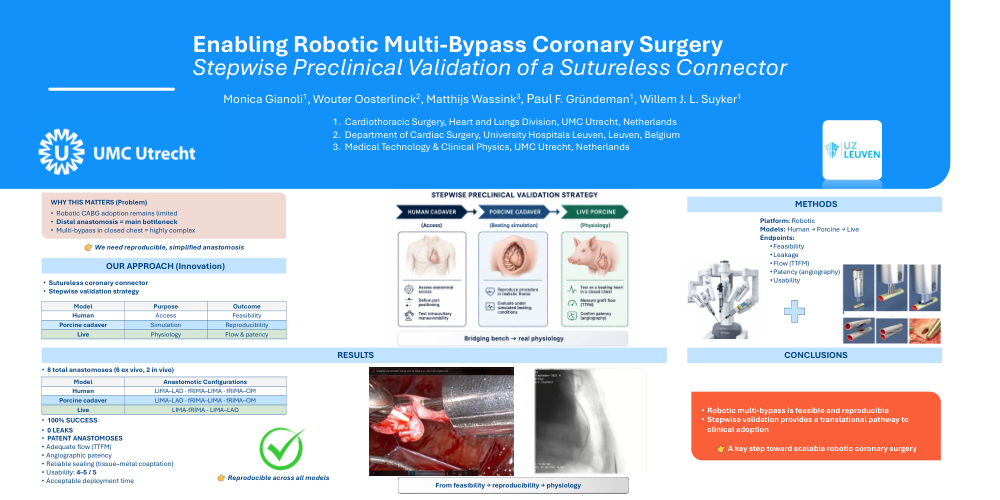
Enabling Robotic Multi-bypass Coronary Surgery: A Stepwise Preclinical Validation Strategy
Poster Presenter
Part of Topic
Coronary Revascularization
Video
Objective
Widespread adoption of robotic and totally endoscopic coronary surgery remains limited by the technical complexity, variability, and learning curve associated with distal coronary anastomosis construction in a closed-chest environment. This study evaluated a stepwise preclinical validation strategy designed to assess feasibility, reproducibility, and performance of a sutureless coronary connector to enable robotic multi-bypass coronary surgery.
Methods
An exploratory study was conducted using a robotic surgical platform across three complementary preclinical models: human cadaver, porcine cadaver with thoracic reconstruction, and live porcine. The human cadaver model was used to assess anatomical access, port positioning, and intracavitary maneuverability. The porcine cadaver model served as an intermediate step toward off-pump live deployment. This model enabled functional and hemodynamic validation under beating-heart conditions.
The primary endpoint was successful robot-assisted anastomosis construction, including multi-bypass configurations. Secondary endpoints included deployment time, leakage classification, and surgeon-reported usability scores. In the live model, graft flow was assessed using transit-time flow measurement, and patency was checked by intraoperative angiography. All procedures were video-recorded for structured review.
Results
A total of six robotic ex vivo and two in vivo anastomoses were performed. In the human cadaver model, three anatomically distinct anastomoses (internal mammary artery to left anterior descending artery, internal mammary artery Y-graft, and internal mammary artery to marginal branch) were completed successfully and were leak-free on hydraulic testing. These anastomoses were reproduced in the porcine cadaver model after thoracic reconstruction, again demonstrating consistent leak-free performance.
In the live porcine experiment, a free mammary artery was connected to the native mammary artery (open connector deployment) as a Y-graft, and a fully robotic internal mammary artery to left anterior descending artery anastomosis was constructed. All anastomoses were leak-free. Transit-time flow measurements demonstrated adequate graft flow, and intraoperative angiography confirmed patency. Surgeon-reported usability scores were consistently high (median 4–5 out of 5), with only minor ergonomic observations noted.
Conclusions
Robotic multi-bypass coronary anastomosis using a sutureless connector was feasible and reproducible across anatomical and physiological preclinical models. This stepwise validation strategy bridges benchtop and live evaluation in a closed-chest environment and provides a predictive framework for enabling reproducible, multi-bypass robotic coronary surgery.