301 posters, 50 videos, 13 topics, 13 sessions, 734 authors, 193 institutions
ePostersLive by SciGen Technologies S.A. All rights reserved.
ISMICS 2026 Annual Meeting
10 - 13 June, 2026 | Miami, Florida

D146
Quality Of Life After Minimally Invasive Versus Sternotomy Valve Surgery: A Contemporary Evidence Synthesis
Poster Presenter
Authors
Andra-Denis Marinescu, Stefan Andrei Oprea, Victor Sebastian Costache
Affiliations
Titu Maiorescu University, Faculty of Medicine, Department of Doctoral Studies, Bucharest, Romania, Titu Maiorescu University, Faculty of Medicine, Department of Doctoral Studies, Bucharest, Romania; Sanador Clinical Hospital, Department of Cardiovascular Surgery, Bucharest, Romania, Titu Maiorescu University, Faculty of Medicine, Department of Cardiovascular Surgery, Bucharest, Romania; Sanador Clinical Hospital, Department of Cardiovascular Surgery, Bucharest, Romania
Part of Topic
Valve � Surgical Valves
Background:
Valvular heart disease remains a major global health burden, particularly in ageing populations. Surgical valve repair or replacement is the gold standard for severe lesions when medical therapy is insufficient.
Minimally invasive valve surgery (MIVS) — right anterior minithoracotomy, partial upper sternotomy and robotic-assisted approaches — increasingly substitutes for median sternotomy (MS), aiming to reduce surgical trauma while preserving safety.
Quality of life (QoL), spanning physical, emotional and social domains, has emerged as a key endpoint in contemporary cardiac surgery, yet evidence comparing MIVS vs MS is heterogeneous.
Aim: synthesise contemporary (2020–2025) evidence on QoL outcomes after MIVS versus MS in adult valve surgery.
Methods:
•Structured contemporary evidence synthesis (2020–2025)
•Databases: PubMed, Scopus, Web of Science, Wiley Online Library
•Period: January 2020 – September 2025
•Adults (≥18 y) undergoing aortic or mitral valve surgery via MIVS or MS
•Validated QoL instruments: SF-36, EQ-5D, MLHFQ, KCCQ
•Effect estimates summarised narratively across QoL domains
•Quality assessment: Cochrane RoB 2 (RCTs), Newcastle–Ottawa (cohorts); GRADE for evidence certainty
Key findings
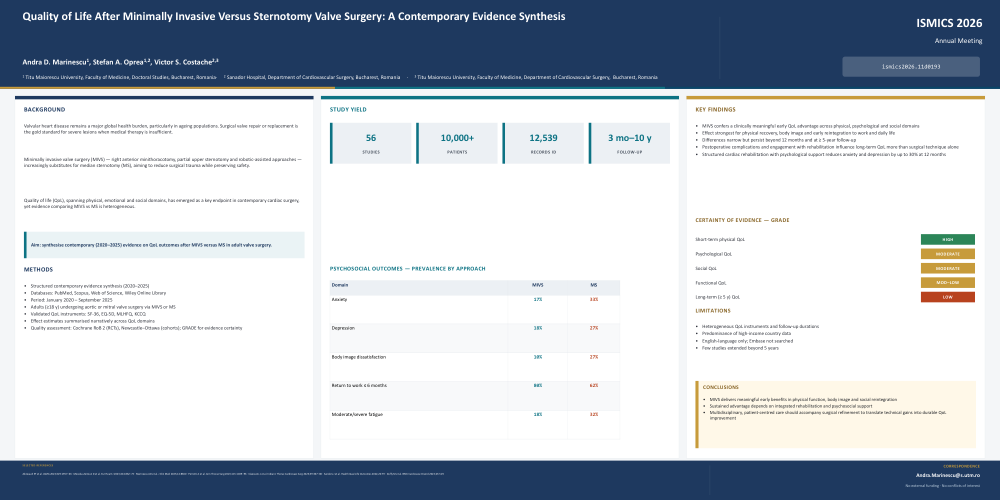
•MIVS confers a clinically meaningful early QoL advantage across physical, psychological and social domains
•Effect strongest for physical recovery, body image and early reintegration to work and daily life
•Differences narrow but persist beyond 12 months and at ≥ 5-year follow-up
•Postoperative complications and engagement with rehabilitation influence long-term QoL more than surgical technique alone
•Structured cardiac rehabilitation with psychological support reduces anxiety and depression by up to 30% at 12 months
Limitations
•Heterogeneous QoL instruments and follow-up durations
•Predominance of high-income country data
•English-language only; Embase not searched
•Few studies extended beyond 5 years
Conclusions
•MIVS delivers meaningful early benefits in physical function, body image and social reintegration
•Sustained advantage depends on integrated rehabilitation and psychosocial support
•Multidisciplinary, patient-centred care should accompany surgical refinement to translate technical gains into durable QoL improvement