301 posters, 50 videos, 13 topics, 13 sessions, 734 authors, 193 institutions
ePostersLive by SciGen Technologies S.A. All rights reserved.
ISMICS 2026 Annual Meeting
10 - 13 June, 2026 | Miami, Florida

D136
A Retrospective Analysis Of Over 25 Years Single Institution Data Of Hybrid Coronary Artery Revascularization
Poster Presenter
Authors
Maria Cannoletta, Simone Martis, Rashmi Yadav, Richard Trimlett, Anthony De Souza
Affiliations
null,
Part of Topic
Coronary Revascularization
A Retrospective Analysis Of over 25 Years Single Institution Data Of Hybrid Coronary Artery Revascularization
BACKGROUND: Endoscopic atraumatic coronary artery bypass surgery (EndoACAB) is a relative new procedure performed in specialist centers. In our institution, this technique is often combined with percutaneous coronary intervention as part of a "hybrid" coronary revascularization approach to achieve complete revascularization for multivessel coronary artery disease. Here, we report our institution results of hybrid coronary revascularization.
METHODS: Retrospective review of single center cardiac surgery database over a period of 25 years and 6 months. Patient characteristics, post-operative complications and in hospital mortality are reported.
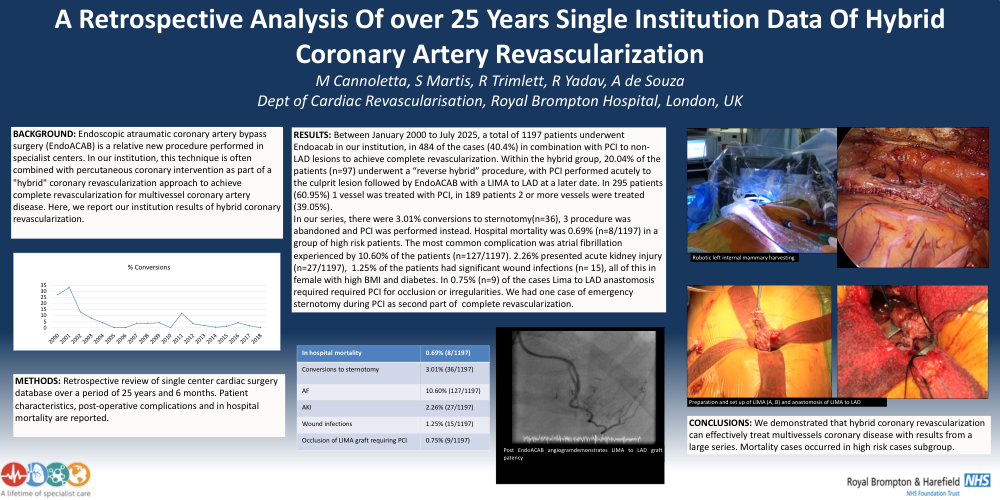
RESULTS: Between January 2000 to July 2025, a total of 1197 patients underwent Endoacab in our institution, in 484 of the cases (40.4%) in combination with PCI to non-LAD lesions to achieve complete revascularization. Within the hybrid group, 20.04% of the patients (n=97) underwent a “reverse hybrid” procedure, with PCI performed acutely to the culprit lesion followed by EndoACAB with a LIMA to LAD at a later date. In 295 patients (60.95%) 1 vessel was treated with PCI, in 189 patients 2 or more vessels were treated (39.05%).
In our series, there were 3.01% conversions to sternotomy(n=36), 3 procedure was abandoned and PCI was performed instead. Hospital mortality was 0.69% (n=8/1197) in a group of high risk patients. The most common complication was atrial fibrillation experienced by 10.60% of the patients (n=127/1197). 2.26% presented acute kidney injury (n=27/1197), 1.25% of the patients had significant wound infections (n= 15), all of this in female with high BMI and diabetes. In 0.75% (n=9) of the cases Lima to LAD anastomosis required required PCI for occlusion or irregularities. We had one case of emergency sternotomy during PCI as second part of complete revascularization.
CONCLUSIONS: We demonstrated that hybrid coronary revascularization can effectively treat multivessels coronary disease with results from a large series. Mortality cases occurred in high risk cases subgroup.