301 posters, 50 videos, 13 topics, 13 sessions, 734 authors, 193 institutions
ePostersLive by SciGen Technologies S.A. All rights reserved.
ISMICS 2026 Annual Meeting
10 - 13 June, 2026 | Miami, Florida

D18
Should We Use Distal Limb Perfusion In All Robotic Mitral Valve Repair Surgery?
Part of Topic
Valve � Surgical Valves
Should We Use Distal Limb Perfusion in All Robotic Mitral Valve Repair Surgery?
Behrooz Banivaheb, Joseph A. Dearani, Richard C. Daly, Phillip G. Rowse, Katie E. Talbott, M.D., Arman Arghami
Introduction: One of the challenges of peripheral cannulation is concern for lower extremity ischemia, leading some surgeons to place a distal limb perfusion cannula (DPC) to protect the cannulated leg. However, the role of DPC during cardiopulmonary bypass (CPB) remains controversial and lacks solid evidence.
Methods: We analyzed all consecutive patients who underwent robotically assisted mitral valve repair between 2020 and 2023. All cases were cannulated via the femoral vessels for cardiopulmonary bypass (CPB). Our practice evolved from transthoracic aortic clamping (352 all clamps) to endoballoon occlusion (59 all balloons) and due to concern for femoral artery occlusion (max cannula size 19 vs 23 Fr) we utilized DPC for the first 11 patients using endoballoon. All perioperative information was collected including highest postoperative serum lactate levels and femoral artery (FA) diameter. Residual diameter was defined as the difference between diameter of FA and cannula.
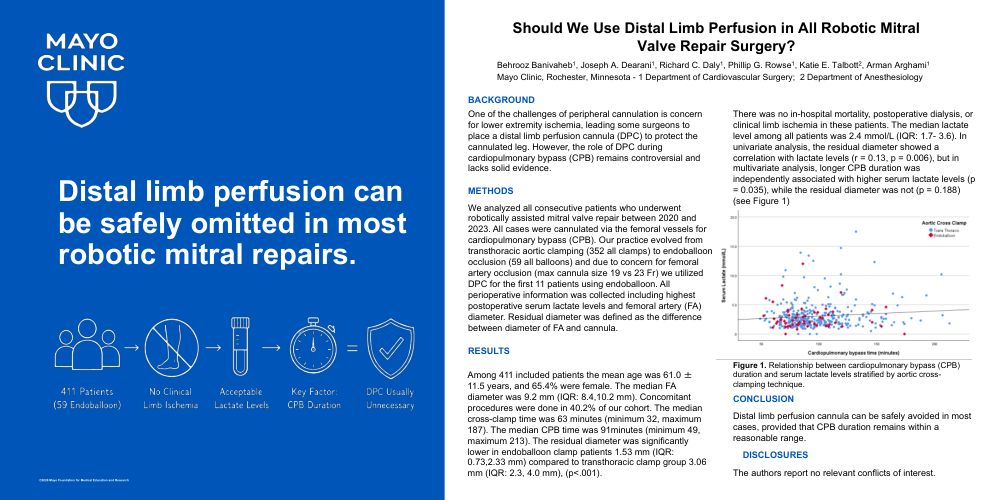
Results: Among 411 included patients the mean age was 61.0 ± 11.5 years, and 65.4% were female. The median FA diameter was 9.2 mm (IQR: 8.4,10.2 mm). Concomitant procedures were done in 40.2% of our cohort. The median cross-clamp time was 63 minutes (minimum 32, maximum 187). The median CPB time was 91minutes (minimum 49, maximum 213). The residual diameter was significantly lower in endoballoon clamp patients 1.53 mm (IQR: 0.73,2.33 mm) compared to transthoracic clamp group 3.06 mm (IQR: 2.3, 4.0 mm), (p<.001). There was no in-hospital mortality, postoperative dialysis, or clinical limb ischemia in these patients. The median lactate level among all patients was 2.4 mmol/L (IQR: 1.7- 3.6). In univariate analysis, the residual diameter showed a correlation with lactate levels (r = 0.13, p = 0.006), but in multivariate analysis, longer CPB duration was independently associated with higher serum lactate levels (p = 0.035), while the residual diameter was not (p = 0.188) (see Figure 1)
Conclusions: Distal limb perfusion cannula can be safely avoided in most cases, provided that CPB duration remains within a reasonable range.