301 posters, 50 videos, 13 topics, 13 sessions, 734 authors, 193 institutions
ePostersLive by SciGen Technologies S.A. All rights reserved.
ISMICS 2026 Annual Meeting
10 - 13 June, 2026 | Miami, Florida

P144
Tavr Explant To Simple Surgical Aortic Valve Replacement Is Safe - But Often More!
Poster Presenter
Part of Topic
Aortic and Endovascular Therapies
This poster focuses on transcatheter aortic valve replacement (TAVR) explantation, surgical aortic valve replacement after TAVR failure, lifetime valve management, procedural complexity, structural valve deterioration, paravalvular leak, endocarditis, aortic surgery, and concomitant cardiac surgical procedures.
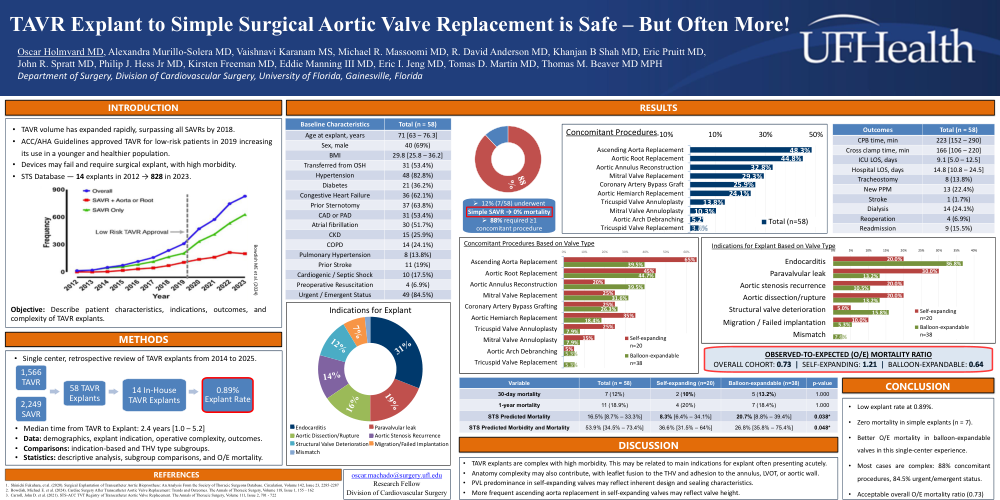
Introduction: There has been an explosion of transcatheter aortic valve replacement (TAVR) into younger and lower-risk populations. Lifetime management depends on long-term durability of these devices and technical challenges associated with surgical explant. This study describes our institutional experience with TAVR explants, focusing on patient characteristics, procedural complexity, and clinical outcomes.
Methods: Retrospective review of TAVR explants performed at one institution from 2014 to 2025. Clinical, procedural, and outcome data were collected. Among 2,249 SAVR and 1,566 TAVR procedures during this period, 58 patients required TAVR explant. Only 0.89% (14/1,566) of in-house TAVRs required explant. Comparisons were performed across key subgroups, including Transferred vs Not Transferred, Endocarditis vs non-Endocarditis and Balloon-Expandable vs Self-Expanding valves. Variables analyzed included demographics, comorbidities, STS-predicted risk, explant indications, intraoperative details, and early outcomes. The primary endpoint was 30-day mortality. Categorical variables were compared using Chi-square or Fisher’s exact test and continuous variables using Mann-Whitney U test.
Results: All 58 patients underwent TAVR explant followed by SAVR. The median interval from index TAVR to explant was 2.4 years [1.0–5.2]. Explanted valves were balloon-expandable in 38 (65%) and self-expanding in 20 (35%). Preoperatively, 10 patients (175%) were in shock and 4 (6.9%) required resuscitation. Endocarditis was more frequent in transferred patients (54.8% vs 3.7%, p < 0.001). COPD was more prevalent in the balloon-expandable group (0% vs 36.8%, p < 0.001). Median ICU and hospital lengths of stay were 9.1 days [5.0–12.5] and 14.8 days [10.8–24.5]. Other baseline demographics and outcomes were similar between groups (Table 1). Most patients (51/58, 88%) required one or more concomitant procedures, including ascending aorta replacement (48.3%) and aortic root replacement (44.8%). Seven patients had isolated SAVR only, with no mortality. The overall thirty-day mortality was 12% (7/58) compared to an STS-predicted mortality of 16.5% [8.7%–33.3%] with an Observed/Expected (O/E) mortality ratio of 0.73. Balloon-expandable valve group had higher STS-predicted operative mortality (20.7 % [8.8–39.4] vs 8.3 % [6.4–34.1], p = 0.038). Thirty-day mortality occurred in 5 (13.2 %) balloon-expandable and 2 (10%) self-expanding cases. Despite this, the O/E mortality ratios were 0.64 for balloon-expandable and 1.2 for self-expanding valves.
Conclusion: The overall TAVR explant rate is low at 0.9%. Balloon-expandable valves showed proportionally lower mortality than expected in this series. Simple explant-to-SAVR (7/58) was safe with no mortality. However, 88% of explants entailed multiple concomitant procedures, with an overall increased but acceptable O/E mortality ratio (0.73), underscoring the complexity of long-term management following TAVR failure.