293 posters, 56 videos, 24 topics, 13 sessions, 658 authors, 215 institutions
ePostersLive by SciGen Technologies S.A. All rights reserved.
ISMICS 2025 Annual Meeting
28 - 31 May, 2025 | Istanbul, Turkey

P93
Uniportal Robot Assisted Thoracic Surgery: Is It Feasible And Safe?
Poster Presenter
Authors
Zeynep Çırak, Mehlika İşcan, Gizem Özçıbık Işık, Tolunay Turan, Ali Yeğinsu
Affiliations
Istanbul University-Cerrahpasa Cerrahpasa Medical Faculty, Department of Thoracic Surgery, Istanbul, Turkey, Başakşehir Çam and Sakura City Hospital, Department of Thoracic Surgery, Istanbul, Turkey, Yedikule Chest Diseases and Thoracic Surgery Teaching Hospital, Department of Thoracic Surgery, Istanbul, Turkey
Part of Topic
Thoracic
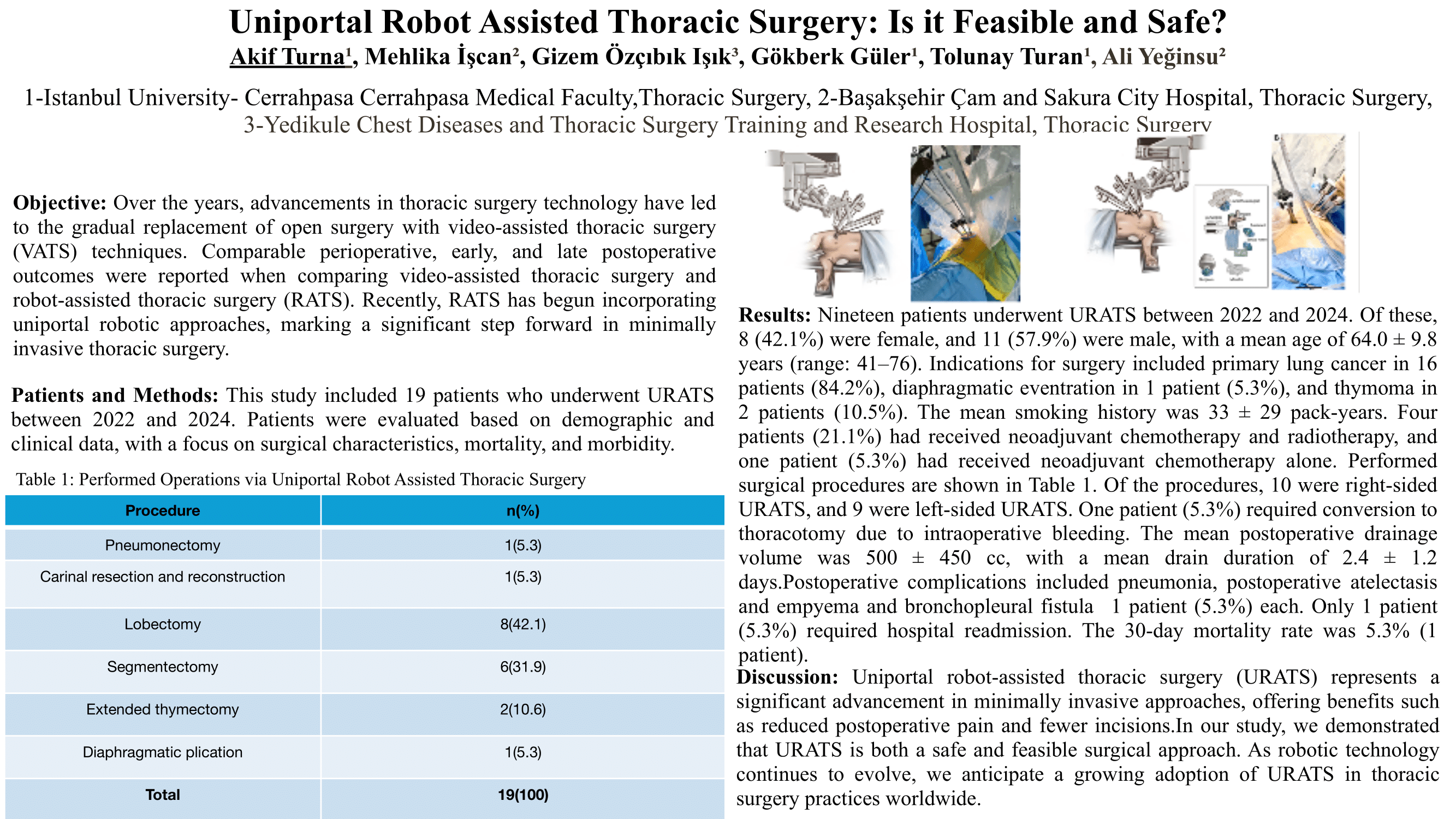
Objective: Over the years, advancements in thoracic surgery technology have led to the gradual replacement of open surgery with video-assisted thoracic surgery (VATS) techniques. Comparable perioperative, early, and late postoperative outcomes were reported when comparing video-assisted thoracic surgery and robot-assisted thoracic surgery (RATS). Recently, RATS has begun incorporating uniportal robotic approaches, marking a significant step forward in minimally invasive thoracic surgery.
Patients and Methods: This study included 19 patients who underwent URATS between 2022 and 2024. Patients were evaluated based on demographic and clinical data, with a focus on surgical characteristics, mortality, and morbidity.
Results: Nineteen patients underwent URATS between 2022 and 2024. Of these, 8 (42.1%) were female, and 11 (57.9%) were male, with a mean age of 64.0 ± 9.8 years (range: 41–76). Indications for surgery included primary lung cancer in 16 patients (84.2%), diaphragmatic eventration in 1 patient (5.3%), and thymoma in 2 patients (10.5%). The mean smoking history was 33 ± 29 pack-years. Four patients (21.1%) had received neoadjuvant chemotherapy and radiotherapy, and one patient (5.3%) had received neoadjuvant chemotherapy alone. Performed surgical procedures are shown in Table 1. Of the procedures, 10 were right-sided URATS, and 9 were left-sided URATS. One patient (5.3%) required conversion to thoracotomy due to intraoperative bleeding. The mean postoperative drainage volume was 500 ± 450 cc, with a mean drain duration of 2.4 ± 1.2 days.Postoperative complications included pneumonia, postoperative atelectasis and empyema and bronchopleural fistula 1 patient (5.3%) each. Only 1 patient (5.3%) required hospital readmission. The 30-day mortality rate was 5.3% (1 patient).
Discussion: Uniportal robot-assisted thoracic surgery (URATS) represents a significant advancement in minimally invasive approaches, offering benefits such as reduced postoperative pain and fewer incisions.In our study, we demonstrated that URATS is both a safe and feasible surgical approach. As robotic technology continues to evolve, we anticipate a growing adoption of URATS in thoracic surgery practices worldwide.
References:
1.Kuo YC, Wu CY, Hsieh MJ, et al. Early Experience of Uniportal Robotic-Assisted Anatomic Resection in Lung Cancer Patients: Is it Safe and Feasible for Direct Transition From Uniportal Video Thoracoscopic-Assisted Surgery to Uniportal Robotic-Assisted Surgery? Asian J Endosc Surg. 2025 Jan-Dec;18(1):e70006
2.Narasimhan A, Samidurai M, Raghupathi N, et al. Uniportal robotic thoracic surgery - an early Indian experience. Indian J Thorac Cardiovasc Surg. 2025 Mar;41(3):288-293.