293 posters, 56 videos, 24 topics, 13 sessions, 658 authors, 215 institutions
ePostersLive by SciGen Technologies S.A. All rights reserved.
ISMICS 2025 Annual Meeting
28 - 31 May, 2025 | Istanbul, Turkey

D1
Totally Thoracoscopic Trans-mitral Myectomy For Hypertrophic Obstructive Cardiomyopathy
Poster Presenter
Authors
Affiliations
Part of Topic
Thoracic Surgery – Miscellaneous
Video
Totally Thoracoscopic Transmitral Myectomy For Hypertrophic Obstructive Cardiomyopathy
Abstract:
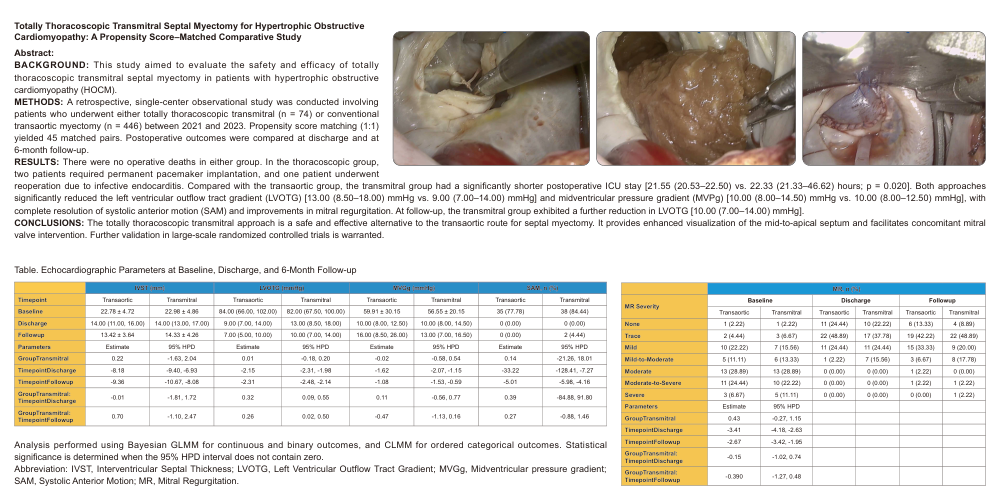
BACKGROUND: The present study was designed to assess the safety and efficacy of the totally thoracoscopic transmitral septal myectomy in patients with hypertrophic obstructive cardiomyopathy.
METHODS: A retrospective single-center observational study was conducted. This involved a comparison between patients who underwent either a totally thoracoscopic transmitral (n =74) or a transaortic myectomy (n =446) between 2021 and 2023. Propensity score matching was carried out at a 1:1 ratio, resulting in 66 matched pairs. The postoperative outcomes at discharge and the 3-month follow-up were compared between the two groups.
RESULTS: There were no operative deaths in either group. In the thoracoscopic group, two patients required permanent pacemaker implantation, and one patient underwent reoperation due to infective endocarditis. Compared with the transaortic group, the transmitral group had significantly shorter postoperative ventilation time [7.00 (6.00–11.00) vs. 10.00 (6.00–15.00) hours; p = 0.020] and hospital stay [6.05 ± 1.65 vs. 6.80 ± 2.75 days; p = 0.033]. Both approaches resulted in significant postoperative reductions in interventricular septal thickness and relief of left ventricular outflow tract obstruction (LVOTG), with gradients at discharge of 12.96 (8.00–17.64) mmHg in the transmitral group and 10.12 (7.84–14.07) mmHg in the transaortic group. There were no significant intergroup differences in left ventricular ejection fraction (64.74 ± 4.89% vs. 64.45 ± 4.61%; p = 0.775) or the severity of mitral regurgitation at discharge and at 3-month follow-up (χ² = 1.86, p = 0.394).
CONCLUSIONS: The totally thoracoscopic transmitral procedure represents a safe and effective alternative to the median sternotomy approach. The thoracoscopic transmitral approach provided advantages in terms of visualizing and exposing the entire interventricular septum, particularly the mid-septal and apical regions, while also facilitating the concurrent management of organic mitral valve pathology. Large-scale randomized controlled trials are warranted to further validate these findings.