293 posters, 56 videos, 24 topics, 13 sessions, 658 authors, 215 institutions
ePostersLive by SciGen Technologies S.A. All rights reserved.
ISMICS 2025 Annual Meeting
28 - 31 May, 2025 | Istanbul, Turkey

P91
Assessing Chylothorax Riskin Minimally Invasive Approaches For Lung Cancer Surgery
Poster Presenter
Part of Topic
Thoracic
OBJECTIVE
Video-Assisted Thoracic Surgery (VATS) and Robot-Assisted Thoracic Surgery (RATS) are widely used minimally invasive surgical (MIS) techniques for lung cancer treatment.
At our institution, Single-Incision Thoracoscopic Surgery (SITS) was introduced in 2013, followed by RATS in 2020, complementing the conventional multi-port VATS (MVATS) approach. These three techniques have been utilized concurrently in lung cancer treatment.
The newer methods, particularly SITS and RATS, provide several advantages over MVATS, including reduced recovery time, lower complication rates, and improved patient satisfaction. SITS minimizes both the size and number of incisions, reduces postoperative pain and accelerating recovery, while RATS enables precise surgical execution, addressing the limitations of traditional techniques.
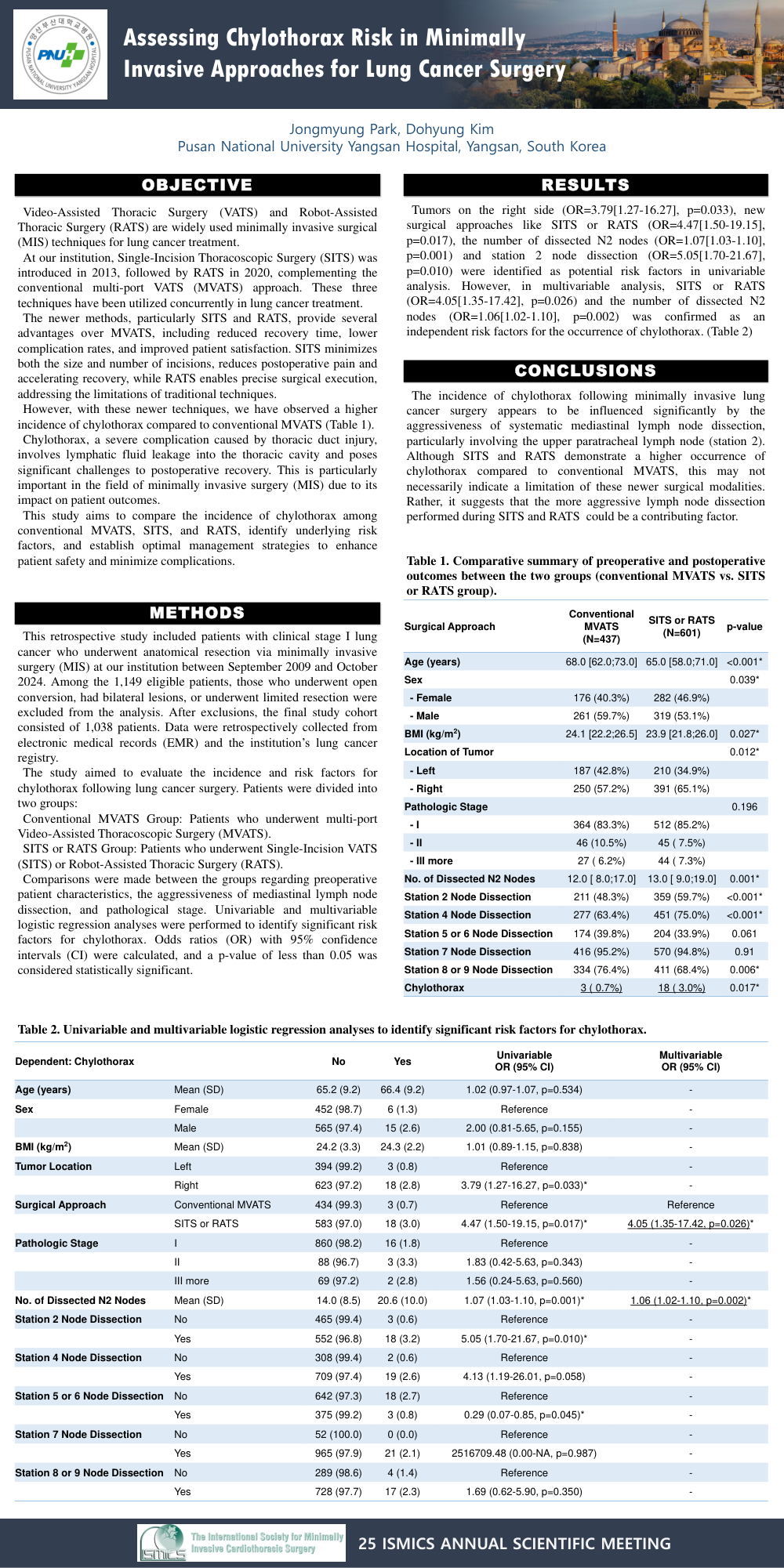
However, with these newer techniques, we have observed a higher incidence of chylothorax compared to conventional MVATS (Table 1).
Chylothorax, a severe complication caused by thoracic duct injury, involves lymphatic fluid leakage into the thoracic cavity and poses significant challenges to postoperative recovery. This is particularly important in the field of minimally invasive surgery (MIS) due to its impact on patient outcomes.
This study aims to compare the incidence of chylothorax among conventional MVATS, SITS, and RATS, identify underlying risk factors, and establish optimal management strategies to enhance patient safety and minimize complications.
METHODS
This retrospective study included patients with clinical stage I lung cancer who underwent anatomical resection via minimally invasive surgery (MIS) at our institution between September 2009 and October 2024. Among the 1,149 eligible patients, those who underwent open conversion, had bilateral lesions, or underwent limited resection were excluded from the analysis. After exclusions, the final study cohort consisted of 1,038 patients. Data were retrospectively collected from electronic medical records (EMR) and the institution’s lung cancer registry.
The study aimed to evaluate the incidence and risk factors for chylothorax following lung cancer surgery. Patients were divided into two groups:
Conventional MVATS Group: Patients who underwent multi-port Video-Assisted Thoracoscopic Surgery (MVATS).
SITS or RATS Group: Patients who underwent Single-Incision VATS (SITS) or Robot-Assisted Thoracic Surgery (RATS).
Comparisons were made between the groups regarding preoperative patient characteristics, the aggressiveness of mediastinal lymph node dissection, and pathological stage. Univariable and multivariable logistic regression analyses were performed to identify significant risk factors for chylothorax. Odds ratios (OR) with 95% confidence intervals (CI) were calculated, and a p-value of less than 0.05 was considered statistically significant.
RESULTS
Tumors on the right side (OR=3.79[1.27-16.27], p=0.033), new surgical approaches like SITS or RATS (OR=4.47[1.50-19.15], p=0.017), the number of dissected N2 nodes (OR=1.07[1.03-1.10], p=0.001) and station 2 node dissection (OR=5.05[1.70-21.67], p=0.010) were identified as potential risk factors in univariable analysis. However, in multivariable analysis, SITS or RATS (OR=4.05[1.35-17.42], p=0.026) and the number of dissected N2 nodes (OR=1.06[1.02-1.10], p=0.002) was confirmed as an independent risk factors for the occurrence of chylothorax. (Table 2)
CONCLUSIONS
The incidence of chylothorax following minimally invasive lung cancer surgery appears to be influenced significantly by the aggressiveness of systematic mediastinal lymph node dissection, particularly involving the upper paratracheal lymph node (station 2). Although SITS and RATS demonstrate a higher occurrence of chylothorax compared to conventional MVATS, this may not necessarily indicate a limitation of these newer surgical modalities. Rather, it suggests that the more aggressive lymph node dissection performed during SITS and RATS could be a contributing factor.