293 posters, 56 videos, 24 topics, 13 sessions, 658 authors, 215 institutions
ePostersLive by SciGen Technologies S.A. All rights reserved.
ISMICS 2025 Annual Meeting
28 - 31 May, 2025 | Istanbul, Turkey

P89
Long Term Trends In Lymph Node Dissection Performed During Uniportal Vats Resection In Lung Cancer Patients
Poster Presenter
Authors
Zeynep Çırak, Melek Ağkoç, Kamil Kaynak, Ezel Erşen, Volkan Kara, Akif Turna
Affiliations
Istanbul University - Cerrahpasa, Cerrahpasa Medical School, Istanbul, Turkey, Erzurum City Hospital, Department of Thoracic Surgery, Erzurum, Turkey, Istanbul University - Cerrahpasa, Cerrahpasa Medical School, Department of Thoracic Surgery, Istanbul, Turkey
Part of Topic
Thoracic
COMPARING OPEN AND VIDEO-THORACOSCOPIC APPROACHES FOR LYMPH NODE DISSECTION IN LUNG CANCER PATIENTS: A PROPENSITY SCORE MATCHING ANALYSIS
Objective: Video-assisted thoracoscopic surgery (VATS), performed through both multiportal and uniportal approaches, has largely replaced thoracotomy as the preferred technique for lung cancer surgery. Despite this shift, the comparative efficacy of thoracotomy versus multiportal and uniportal VATS in achieving optimal lymph node dissection in oncologic surgery remains an area of active research and debate.
Methods: A retrospective review was conducted on 766 patients who underwent lung resection for primary lung cancer between October 2001 and January 2024. Demographic, clinical, and pathological data were collected for all patients. The cohort was stratified into three categories corresponding to the VATS learning curve phases in our department: early (2001–2016), intermediate (2017–2020), and late (2021–2024). Propensity score matching (PSM) was performed in a 1:1 ratio, matching for age, gender, tumor-node-metastasis (TNM) staging, and preoperative surgical mediastinal staging status. The number of dissected lymph nodes across the three groups was compared using the Kruskal-Wallis test.
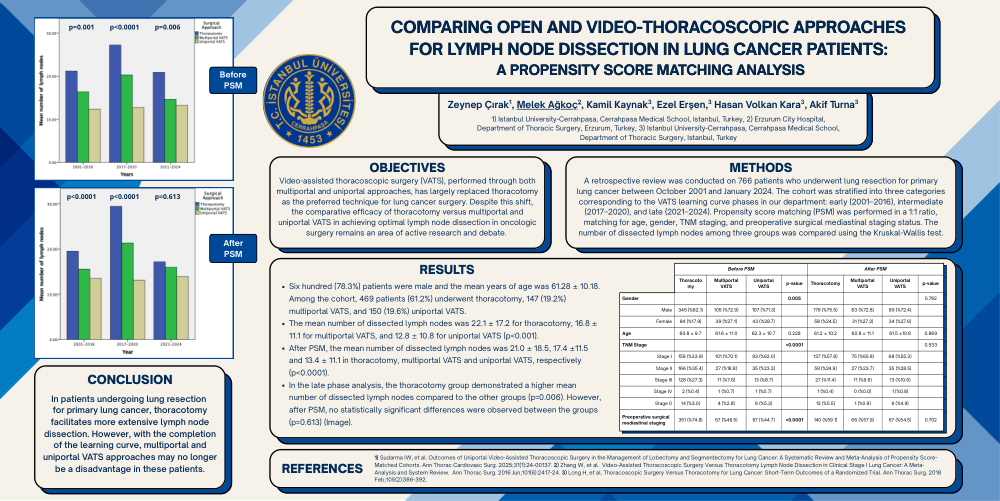
Results: Six hundred (78.3%) patients were male and the mean years of age was 61.28 ± 10.18. Among the cohort, 469 patients (61.2%) underwent thoracotomy, 147 patients (19.2%) underwent multiportal VATS, and 150 patients (19.6%) underwent uniportal VATS. The mean number of dissected lymph nodes was 22.1 ± 17.2 for thoracotomy, 16.8 ± 11.1 for multiportal VATS, and 12.8 ± 10.8 for uniportal VATS (p<0.001). The demographic and clinical characteristics of the groups, both before and after propensity score matching (PSM), are summarized in Table 1. After PSM, the mean number of dissected lymph nodes was 21.0 ± 18.5, 17.4 ±11.5 and 13.4 ± 11.1 in thoracotomy, multiportal VATS and uniportal VATS, respectively (p<0.0001). In the late phase analysis, the thoracotomy group demonstrated a higher mean number of dissected lymph nodes compared to the other groups (p=0.006). However, after PSM, no statistically significant differences were observed between the groups (p=0.613) (Image 1).
Conclusion: In patients undergoing lung resection for primary lung cancer, thoracotomy facilitates more extensive lymph node dissection. However, with the completion of the learning curve, multiportal and uniportal VATS approaches may no longer be a disadvantage in these patients.