293 posters, 56 videos, 24 topics, 13 sessions, 658 authors, 215 institutions
ePostersLive by SciGen Technologies S.A. All rights reserved.
ISMICS 2025 Annual Meeting
28 - 31 May, 2025 | Istanbul, Turkey

P88
Clinical Outcomes Of "unisurgeon" Video-assisted Thoracoscopic Surgery Lobectomy: A Single-center Experience
Poster Presenter
Authors
Part of Topic
Thoracic
Video
Clinical Outcomes Of "unisurgeon" Video-assisted Thoracoscopic Surgery Lobectomy: A Single-center Experience
Abstract
The "unisurgeon" concept, introduced by Gonzalez-Rivas in 2017, refers to video-assisted thoracoscopic surgery (VATS) performed by a single surgeon without a scrubbed assistant, aided by a mechanical camera holder. This study evaluates the clinical outcomes of unisurgeon VATS lobectomy in a retrospective series of 50 patients. A two-port technique was used for lower lobectomies and a three-port technique for upper lobectomies. Patient demographics, operative details, and postoperative outcomes were reviewed. The most common indication was lung cancer (46%). The conversion rate was 6%, and postoperative complications occurred in 14% of cases. Unisurgeon VATS lobectomy appears to be a feasible and safe technique for anatomical lung resections, with acceptable complication rates and potential benefits in resource-limited settings.
Introduction
Video-assisted thoracoscopic surgery (VATS) has become a standard approach for lung resections due to its advantages in reducing postoperative pain and accelerating recovery. Traditionally, these procedures require a surgical assistant to maintain camera positioning and lung retraction. The unisurgeon technique eliminates the need for an assistant by incorporating mechanical or robotic camera holders. This approach allows a single surgeon to perform complex thoracic procedures independently. Our study aimed to evaluate the safety, feasibility, and clinical outcomes of unisurgeon VATS lobectomy performed at a single center.
Materials and Methods
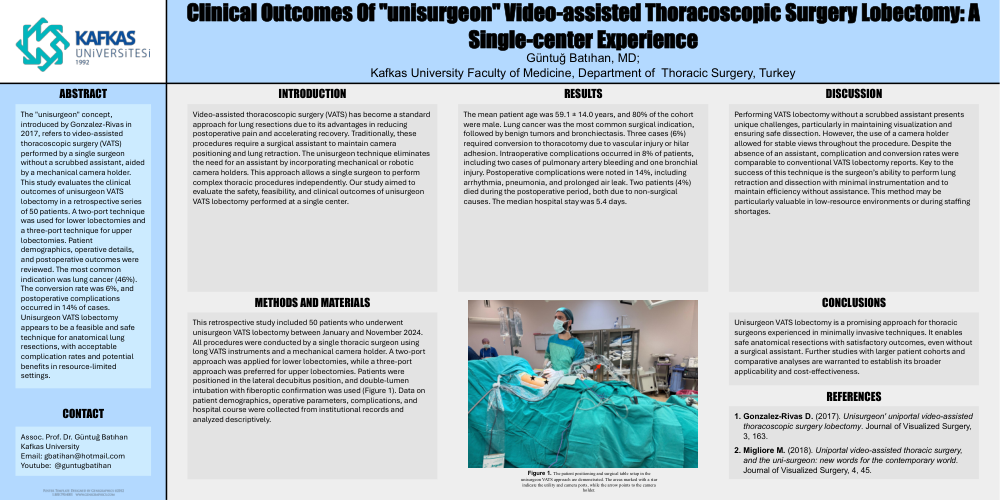
This retrospective study included 50 patients who underwent unisurgeon VATS lobectomy between January and November 2024. All procedures were conducted by a single thoracic surgeon using long VATS instruments and a mechanical camera holder. A two-port approach was applied for lower lobectomies, while a three-port approach was preferred for upper lobectomies. Patients were positioned in the lateral decubitus position, and double-lumen intubation with fiberoptic confirmation was used. Data on patient demographics, operative parameters, complications, and hospital course were collected from institutional records and analyzed descriptively.
Results
The mean patient age was 59.1 ± 14.0 years, and 80% of the cohort were male. Lung cancer was the most common surgical indication, followed by benign tumors and bronchiectasis. Three cases (6%) required conversion to thoracotomy due to vascular injury or hilar adhesion. Intraoperative complications occurred in 8% of patients, including two cases of pulmonary artery bleeding and one bronchial injury. Postoperative complications were noted in 14%, including arrhythmia, pneumonia, and prolonged air leak. Two patients (4%) died during the postoperative period, both due to non-surgical causes. The median hospital stay was 5.4 days.
Discussion
Performing VATS lobectomy without a scrubbed assistant presents unique challenges, particularly in maintaining visualization and ensuring safe dissection. However, the use of a camera holder allowed for stable views throughout the procedure. Despite the absence of an assistant, complication and conversion rates were comparable to conventional VATS lobectomy reports. Key to the success of this technique is the surgeon’s ability to perform lung retraction and dissection with minimal instrumentation and to maintain efficiency without assistance. This method may be particularly valuable in low-resource environments or during staffing shortages.
Conclusions
Unisurgeon VATS lobectomy is a promising approach for thoracic surgeons experienced in minimally invasive techniques. It enables safe anatomical resections with satisfactory outcomes, even without a surgical assistant. Further studies with larger patient cohorts and comparative analyses are warranted to establish its broader applicability and cost-effectiveness.