293 posters, 56 videos, 24 topics, 13 sessions, 658 authors, 215 institutions
ePostersLive by SciGen Technologies S.A. All rights reserved.
ISMICS 2025 Annual Meeting
28 - 31 May, 2025 | Istanbul, Turkey

P7
"ez2-bsafer" Type A Aortic Dissection Repair With Zone 2 Debranching: Reducing Pseudoaneurysm Formation And Reintervention Rate
Part of Topic
Aortic and Endovasc
Video
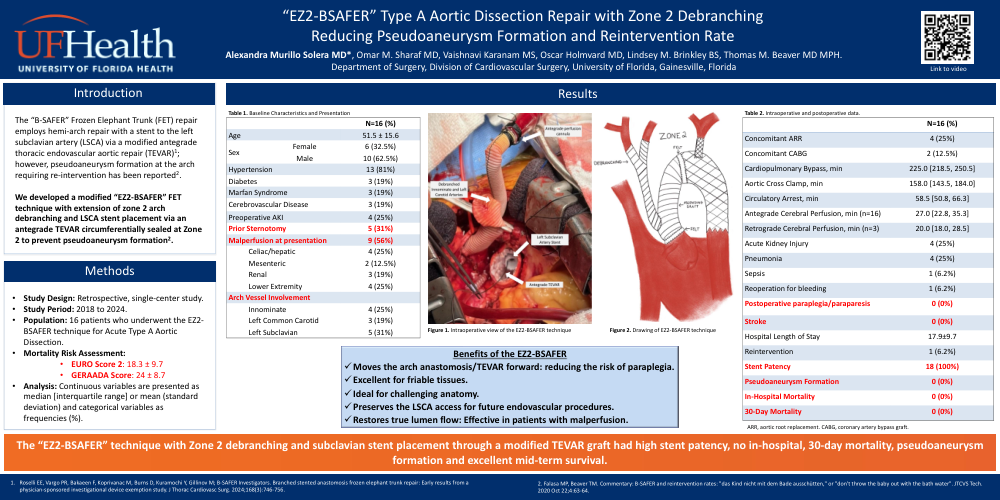
Objective: The “B-SAFER” Frozen Elephant Trunk (FET) repair employs hemi-arch repair with a stent to the left subclavian artery (LSCA) via a modified antegrade thoracic endovascular aortic repair (TEVAR); however, pseudoaneurysm formation at the arch requiring re-intervention has been reported. We developed a modified “EZ2-BSAFER” FET technique with extension of zone 2 arch debranching and LSCA stent placement via an antegrade TEVAR circumferentially sealed at Zone 2 to prevent pseudoaneurysm formation.
Methods: Single center retrospective review of 16 adult patients (≥18 years) who underwent the EZ2-BSAFER technique between 2018 and 2024. Primary outcomes were pseudoaneurysm formation, LSCA stent patency, reintervention rate, and survival. Descriptive statistics were performed using SPSS (Armonk, NY, USA).
Results: The cohort included 10 males and 6 females (51.5 ± 15.6 years) with a mean EUROScore2 of 18.3 ± 9.7% and a mean GERAADA Score of 24 ± 8.7%. Comorbidities included hypertension (81.2%, n=13), cerebrovascular disease (18.7%, n=3), diabetes (18.7%, n=3), preoperative acute kidney injury (25%, n=4), Marfan syndrome (18.7%, n=3), and prior sternotomy (31.2%, n=5). Malperfusion was present in 9 (56%) patients. Patient statistics are displayed (Table 1). One patient required open repair for contained rupture of residual descending aortic aneurysm. Other postoperative complications included acute renal failure (25%, n=4) with three patients requiring dialysis, pneumonia (25%, n=4), sepsis (6.2%, n=1), and reoperation for bleeding (6.2%, n=1). No patients had postoperative paraplegia, permanent stroke or required tracheostomy. Mean postoperative length of stay was 17.9 ± 9.7 days. All patients survived to discharge with no 30-day mortality. Median follow-up time was 625 (IQR = 214-1194) days. During follow-up one (6.2%, n=1/16) patient required reintervention 2.3 years after the index surgery due to type 1B and type 2 endoleak from the LSCA and thoracoabdominal aortic degeneration. The patient underwent TEVAR extension and LSCA stent extension. Overall, LSCA stent patency was 100% with no cases of pseudoaneurysm formation.
Conclusions: The “EZ2-BSAFER” technique with Zone 2 Debranching and subclavian stent placement through a modified TEVAR graft had high stent patency, no in-hospital or 30-day mortality, no pseudoaneurysm formation and excellent mid-term survival.