293 posters, 56 videos, 24 topics, 13 sessions, 658 authors, 215 institutions
ePostersLive by SciGen Technologies S.A. All rights reserved.
ISMICS 2025 Annual Meeting
28 - 31 May, 2025 | Istanbul, Turkey

D115
Thrombin Gel Matrix As A Novel Treatment For Lymphatic Fistula After Inguinal Approach In Minimally Invasive Cardiovascular Surgery
Poster Presenter
Authors
Affiliations
Part of Topic
Aortic and Endovascular Therapies
Thrombin Gel Matrix As A Novel Treatment For Lymphatic Fistula After Inguinal Approach In Minimally Invasive Cardiovascular Surgery
José Francisco Valderrama-Marcos1,2, Alberto Martín-Palanca2, Carmen Ramos-Cantos2, Julia Fernández-Castañer1, Ignacio Tribes-Caballero1, Sergio González-González1.
1Hospital Regional Universitario de Málaga, Málaga, Spain | 2HospitalVithas Málaga, Málaga, Spain.
Background:
Postoperative lymphatic leakage is a rare but well-known phenomenon after inguinal approach in minimally invasive cardiovascular surgery. Although it is usually not severe, it generally increases pain, hospital stay, and the risk of dehiscence and surgical site infections. Thrombin gel matrix has been used in prevention but has not been reported for treatment. We describe its use for effective closure of a lymphatic fistula.
Methods:
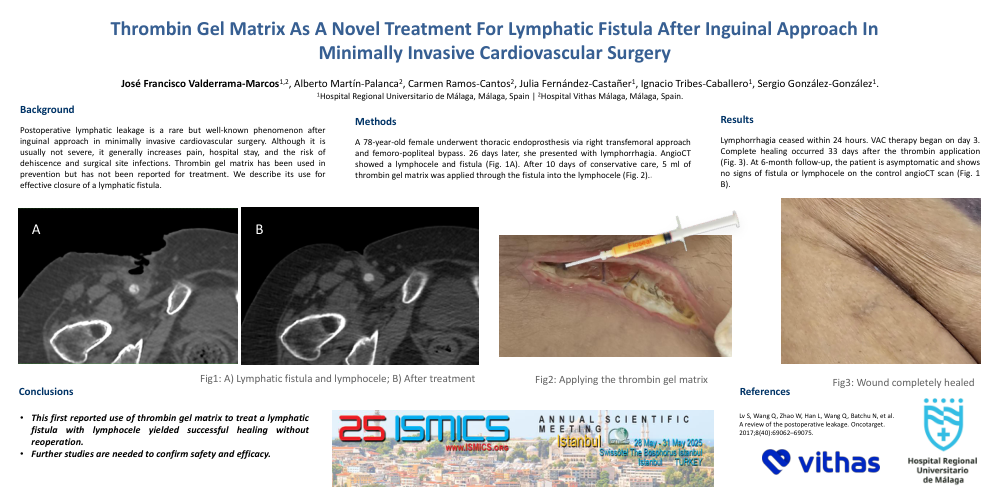
A 78-year-old female underwent thoracic endoprosthesis via right transfemoral approach and femoro-popliteal bypass. 26 days later, she presented with lymphorrhagia. AngioCTshowed a lymphocele and fistula (Fig. 1A). After 10 days of conservative care, 5 ml of thrombin gel matrix was applied through the fistula into the lymphocele(Fig. 2)..
Results:
Lymphorrhagia ceased within 24 hours. VAC therapy began on day 3. Complete healing occurred 33 days after the thrombin application (Fig. 3). At 6-month follow-up, the patient isasymptomatic and shows no signs offistula or lymphocele on the control angioCT scan (Fig. 1 B).
Conclusions
Lv S, Wang Q, Zhao W, Han L, Wang Q, Batchu N, et al. A review of the postoperative leakage. Oncotarget. 2017;8(40):69062–69075.