293 posters, 56 videos, 24 topics, 13 sessions, 658 authors, 215 institutions
ePostersLive by SciGen Technologies S.A. All rights reserved.
ISMICS 2025 Annual Meeting
28 - 31 May, 2025 | Istanbul, Turkey
P6
Totally Endoscopic Replacement Of The Ascending Aorta With 3d Visualization: Defining 'totally Endoscopic'? A Case Report
Poster Presenter
Authors
Thuan Phan, Chuong Pham, Thang Ho, Huy Lam, Luan Tran, Dinh Nguyen
Affiliations
Part of Topic
Aortic and Endovasc
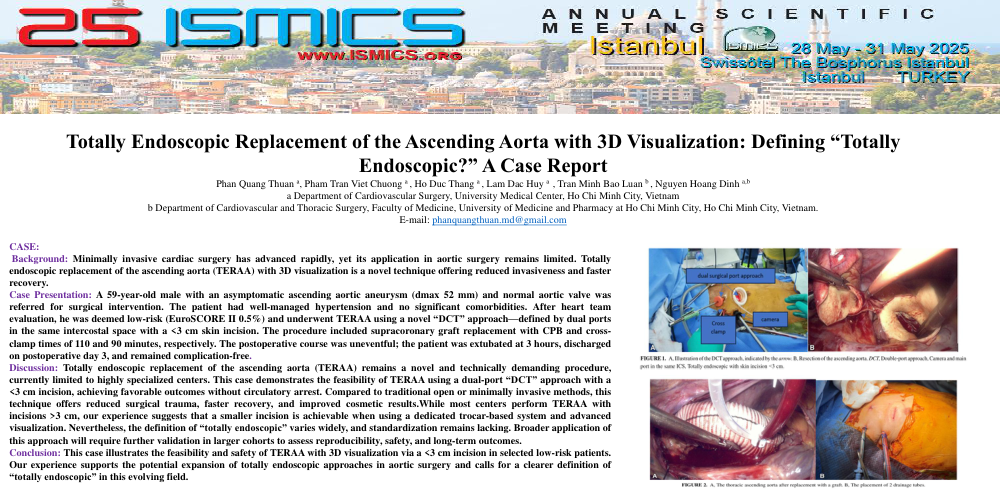
Totally Endoscopic Replacement of the Ascending Aorta with 3D Visualization: Defining “Totally Endoscopic?” A Case Report Phan Quang Thuan a, Pham Tran Viet Chuong a ,Nguyen Hoang Dinh a a Department of Cardiovascular Surgery, University Medical Center, Ho Chi Minh City, Vietnam E-mail: phanquangthuan.md@gmail.com CASE: Background: Minimally invasive cardiac surgery has advanced rapidly, yet its application in aortic surgery remains limited. Totally endoscopic replacement of the ascending aorta (TERAA) with 3D visualization is a novel technique offering reduced invasiveness and faster recovery. Case Presentation: A 59-year-old male with an asymptomatic ascending aortic aneurysm (dmax 52 mm) and normal aortic valve was referred for surgical intervention. The patient had well-managed hypertension and no significant comorbidities. After heart team evaluation, he was deemed low-risk (EuroSCORE II 0.5%) and underwent TERAA using a novel “DCT” approach—defined by dual ports in the same intercostal space with a <3 cm skin incision. The procedure included supracoronary graft replacement with CPB and cross clamp times of 110 and 90 minutes, respectively. The postoperative course was uneventful; the patient was extubated at 3 hours, discharged on postoperative day 3, and remained complication-free. Discussion: Totally endoscopic replacement of the ascending aorta (TERAA) remains a novel and technically demanding procedure, currently limited to highly specialized centers. This case demonstrates the feasibility of TERAA using a dual-port “DCT” approach with a <3 cm incision, achieving favorable outcomes without circulatory arrest. Compared to traditional open or minimally invasive methods, this technique offers reduced surgical trauma, faster recovery, and improved cosmetic results.While most centers perform TERAA with incisions >3 cm, our experience suggests that a smaller incision is achievable when using a dedicated trocar-based system and advanced visualization. Nevertheless, the definition of “totally endoscopic” varies widely, and standardization remains lacking. Broader application of this approach will require further validation in larger cohorts to assess reproducibility, safety, and long-term outcomes. Conclusion: This case illustrates the feasibility and safety of TERAA with 3D visualization via a <3 cm incision in selected low-risk patients. Our experience supports the potential expansion of totally endoscopic approaches in aortic surgery and calls for a clearer definition of “totally endoscopic” in this evolving field