293 posters, 56 videos, 24 topics, 13 sessions, 658 authors, 215 institutions
ePostersLive by SciGen Technologies S.A. All rights reserved.
ISMICS 2025 Annual Meeting
28 - 31 May, 2025 | Istanbul, Turkey

D178
Comparison Of Port Access To Sternotomy In Redo Tricuspid Valve Surgery Single Center Outcomes
Poster Presenter
Authors
Onur Büyükçakır, Fatma Akça, Ali Fuat Karaçuha, Onur Büyükçakır, Emre Şen, Mustafa Bahadır İnan, Ahmet Rüçhan Akar, Sadık Eryılmaz
Affiliations
Kırıkkale High Specialization Hospital, Ankara University Faculty of Medicine,Department of Cardiovascular Surgery, Trabzon Kanuni Training and Research Hospital
Part of Topic
Valve – Surgical Valves
Comparison Of Port Access To Sternotomy In Redo Tricuspid Valve Surgery Single Center Outcomes:
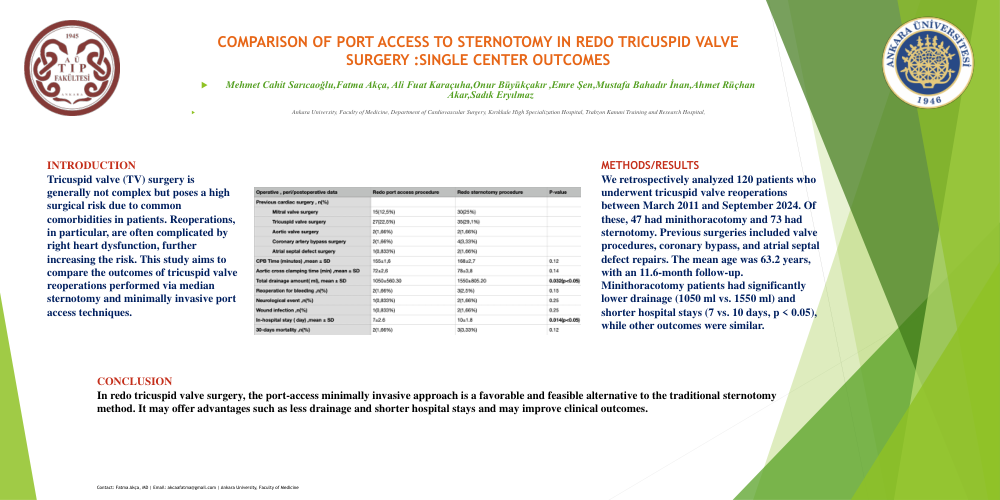
Author Block: Mehmet Cahit Sarıcaoğlu1, Fatma Akça1, Ali Fuat Karaçuha2, Onur Büyükçakır1, Emre Şen1, Mustafa Bahadır İnan1, Ahmet Rüçhan Akar1, Sadık Eryılmaz1.
1Ankara University, Ankara, Turkey, 2Trabzon Kanuni Training and Research Hospital, Trabzon, Turkey.
Abstract:
BACKGROUND: Tricuspid valve(TV)surgery is not inherently complex however,it carries a high surgical risk due to the associated comorbidities in many patients .Patients with tricuspid valve pathology, particularly in reoperations, often have additional complications related to right heart dysfunction, which is closely associated with increased surgical risk. The aim of this study was to compare tricuspid valve reoperation outcomes between median sternotomy and minimally invasive techniques with port access.METHODS:We performed a retrospective analysis of 120 patients who underwent tricuspid valve (TV) surgery as a reoperation at single center between march 2011 and september 2024. Among 120 patients , 47 underwent minithoracotomy(minimal group) and 73 underwent sternotomy.Previous operations included mitral, tricuspid, and aortic valve surgeries,coronary artery bypass surgeries, as well as atrial septal defect repair procedures.The mean age was 63.2±8.6,follow-up 11.6±7.8 months.Procedures were performed on beating hearts with normothermic cardiopulmonary bypass. RESULTS: The jugular vein and the right/left common femoral vein were cannulated using the Seldinger technique. Cut-down incision was performed at groin for arterial cannulation, preferably in the right common femoral artery. In the minimal group, a skin incision of approximately 5 cm was made just beneath the right nipple in men and on the right inframammary groove in women. Port access was through the fourth intercostal space. All patients successfully underwent elective surgery without any intraoperative mortality. Basic demographic characteristics and vital organ functions, including cardiac, hepatic, and renal functions, are homogeneously distributed and there were no significant differences in both groups. In the minimal group, the total drainage amount and average length of stay were significantly lower: 1050 ± 560.30 ml/ 1550 ± 805.20 ml, and 7 ± 2.6 days/10 ± 1.8 days, respectively (p<0.05), while other perioperative and postoperative data were similar.CONCLUSIONS:In redo tricuspid valve surgery, the port-access minimally invasive approach is a favorable and feasible alternative to the traditional sternotomy method. It may offer advantages such as less drainage and shorter hospital stays and may improve clinical outcomes.