293 posters, 56 videos, 24 topics, 13 sessions, 658 authors, 215 institutions
ePostersLive by SciGen Technologies S.A. All rights reserved.
ISMICS 2025 Annual Meeting
28 - 31 May, 2025 | Istanbul, Turkey

D100
Mid-term Echocardiographic Outcomes Of Minimally Invasive Mitral Valve Repair
Part of Topic
Valve – Surgical Valves
Mid-term Echocardiographic Outcomes Of Minimally Invasive Mitral Valve Repair
Nicolas Mourad, BSc1, Rosalind Groenewoud, MD2, Durr Al-Hakim, BSc1, Bader Al-Zeer, BSc1, Neil Wu, BSc2, Richard C. Cook, MD2
(1) Faculty of Medicine, University of British Columbia, Vancouver, BC; (2) Department of Cardiac Surgery, University of British Columbia, Vancouver, BC
Background
Minimally invasive (MIS) mitral valve surgery (MVS) offers many benefits including expedited patient recovery with shorter ICU and hospital stays, fewer blood transfusions, enhanced patient satisfaction, and reduced healthcare costs1.
Despite advancements in the MIS MVS field, a gap remains in our understanding of long-term outcomes for this patient population. Existing studies2,3, while informative, often focus on mortality rates and rates of re-operations.
This paper aims to characterize the mid- and long-term echocardiographic characteristics in the MIS mitral valve repair (MVr) population.
Methods
Retrospective review of all records of all 208 adult patients who underwent MIS MVr at our institution between 2006-2021.
The repair’s durability was assessed intraoperatively, at 1-year, 1-3 years, 3-5 years, and 5+ years follow-up post-operation.
The surgical technique involved a mini- thoracotomy, femoral cannulation, antegrade & retrograde cardioplegia, and valve repair with annuloplasty ring placement by a single surgeon (R.C.).
Outcomes included: (1) post-operative mortality, (2) complications, (3) post-operative moderate-to- severe (grade 3) or severe (grade 4) MR, (4) and post-operative ejection fraction (EF).
Results
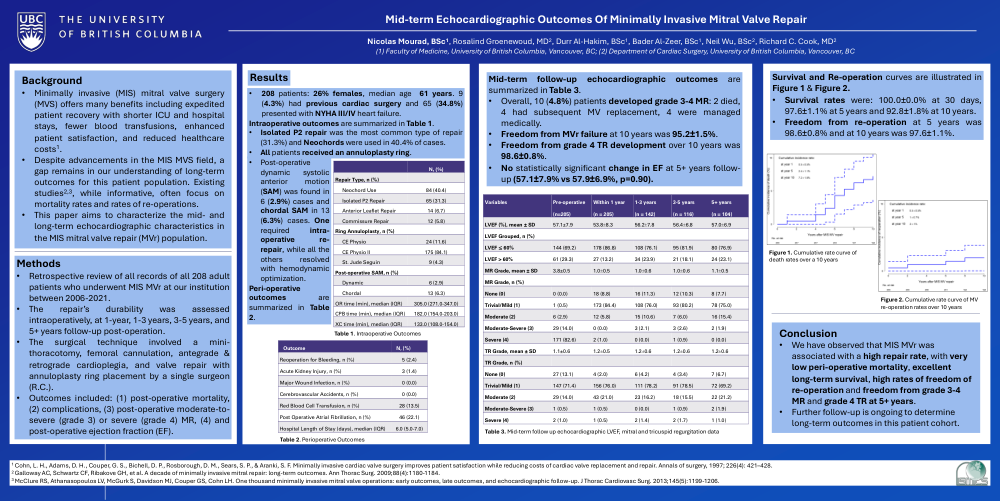
208 patients: 26% females, median age 61 years. 9 (4.3%) had previous cardiac surgery and 65 (34.8%) presented with NYHA III/IV heart failure.
Intraoperative outcomes are summarized in Table 1: Isolated P2 repair was the most common type of repair (31.3%) and Neochords were used in 40.4% of cases. All patients received an annuloplasty ring. Post-operative dynamic systolic anterior motion (SAM) was found in 6 (2.9%) cases and chordal SAM in 13 (6.3%) cases. One required intra- operative re- repair, while all the others resolved with hemodynamic optimization.
Peri-operative outcomes are summarized in Table 2.
Mid-term follow-up echocardiographic outcomes are summarized in Table 3. Overall, 10 (4.8%) patients developed grade 3-4 MR: 2 died, 4 had subsequent MV replacement, 4 were managed medically. Freedom from MVr failure at 10 years was 95.2±1.5%. Freedom from grade 4 TR development over 10 years was 98.6±0.8%. No statistically significant change in EF at 5+ years follow-up (57.1±7.9% vs 57.9±6.9%, p=0.90).
Survival and Re-operation curves are illustrated in Figure 1 & Figure 2. Survival rates were: 100.0±0.0% at 30 days, 97.6±1.1% at 5 years and 92.8±1.8% at 10 years. Freedom from re-operation at 5 years was 98.6±0.8% and at 10 years was 97.6±1.1%.
Conclusion
We have observed that MIS MVr was associated with a high repair rate, with very low peri-operative mortality, excellent long-term survival, high rates of freedom of re-operation and freedom from grade 3-4 MR and grade 4 TR at 5+ years.
Further follow-up is ongoing to determine long-term outcomes in this patient cohort.