293 posters, 56 videos, 24 topics, 13 sessions, 658 authors, 215 institutions
ePostersLive by SciGen Technologies S.A. All rights reserved.
ISMICS 2025 Annual Meeting
28 - 31 May, 2025 | Istanbul, Turkey

D173
Tricuspid Valve Replacement With A Novel Aortic Bioprosthesis
Part of Topic
Valve – Surgical Valves
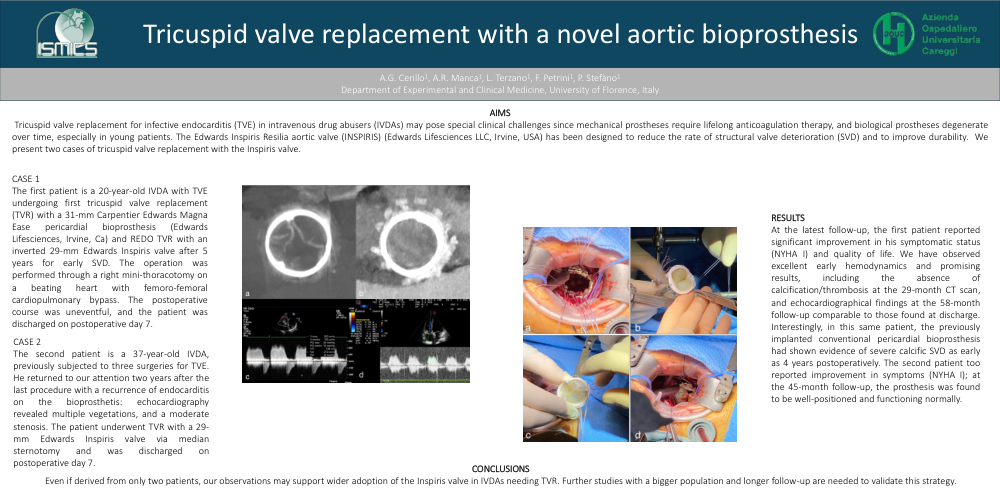
BACKGROUND: Tricuspid valve replacement for infective endocarditis (TVE) in intravenous drug abusers (IVDAs) may pose special clinical challenges since mechanical prostheses require lifelong anticoagulation therapy, and biological prostheses degenerate over time, especially in young patients. The Edwards Inspiris Resilia aortic valve (INSPIRIS) (Edwards Lifesciences LLC, Irvine, USA) has been designed to reduce the rate of structural valve deterioration (SVD) and to improve durability. We present two cases of tricuspid valve replacement with the Inspiris valve. METHODS:The first patient is a 20-year-old IVDA with TVE undergoing first tricuspid valve replacement (TVR) with a 31-mm Carpentier Edwards Magna Ease pericardial bioprosthesis (Edwards Lifesciences, Irvine, Ca) and REDO TVR with an inverted 29-mm Edwards Inspiris valve after 5 years for early SVD. The operation was performed through a right mini-thoracotomy on a beating heart with femoro-femoral cardiopulmonary bypass. The postoperative course was uneventful, and the patient was discharged on postoperative day 7. The second patient is a 37-year-old IVDA, previously subjected to three surgeries for TVE. He returned to our attention two years after the last procedure with a recurrence of endocarditis on the bioprosthetis: echocardiography revealed multiple vegetations, and a moderate stenosis. The patient underwent TVR with a 29-mm Edwards Inspiris valve via median sternotomy and was discharged on postoperative day 7. RESULTS: At the latest follow-up, the first patient reported significant improvement in his symptomatic status (NYHA I) and quality of life. We have observed excellent early hemodynamics and promising results, including the absence of calcification/thrombosis at the 29-month CT scan, and echocardiographical findings at the 58-month follow-up comparable to those found at discharge. Interestingly, in this same patient, the previously implanted conventional pericardial bioprosthesis had shown evidence of severe calcific SVD as early as 4 years postoperatively. The second patient too reported improvement in symptoms (NYHA I); at the 45-month follow-up, the prosthesis was found to be well-positioned and functioning normally.
CONCLUSIONS: Even if derived from only two patients, our observations may support wider adoption of the Inspiris valve in IVDAs needing TVR. Further studies with a bigger population and longer follow-up are needed to validate this strategy.