293 posters, 56 videos, 24 topics, 13 sessions, 658 authors, 215 institutions
ePostersLive by SciGen Technologies S.A. All rights reserved.
ISMICS 2025 Annual Meeting
28 - 31 May, 2025 | Istanbul, Turkey

D163
Focus On Patient-prosthesis Mismatch: Can We Perform Aortic Annulus Enlargement With A Minimally Invasive Approach?
Poster Presenter
Authors
Part of Topic
Valve – Surgical Valves
Background
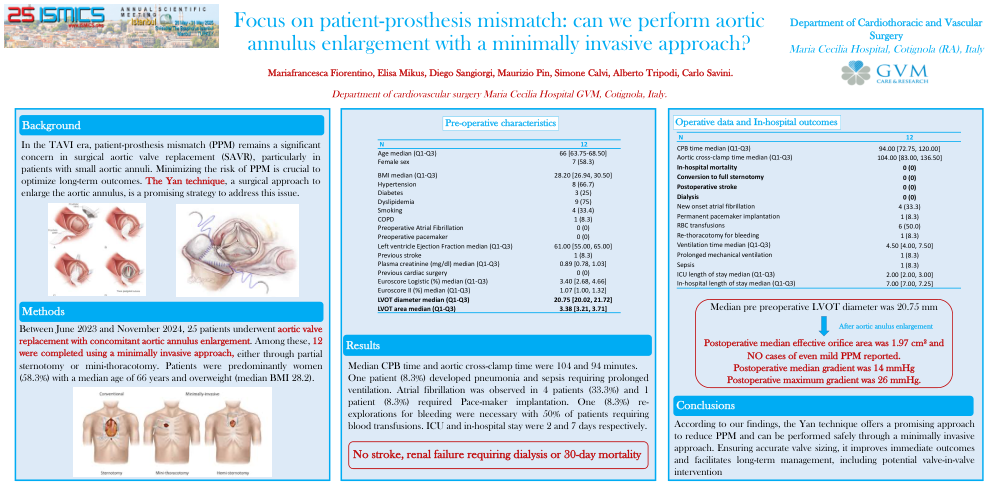
In the TAVI era, patient-prosthesis mismatch (PPM) remains a significant concern in surgical aortic valve replacement (SAVR), particularly in patients with small aortic annuli. Minimizing the risk of PPM is crucial to optimize long-term outcomes. The Yan technique, a surgical approach to enlarge the aortic annulus, is a promising strategy to address this issue.
Methods
Between June 2023 and November 2024, 25 patients underwent aortic valve replacement with concomitant aortic annulus enlargement. Among these, 12 were completed using a minimally invasive approach, either through partial sternotomy or mini-thoracotomy. Patients were predominantly women (58.3%) with a median age of 66 years and overweight (median BMI 28.2).
Results
Median CPB time and aortic cross-clamp time were 104 and 94 minutes. One patient (8.3%) developed pneumonia and sepsis requiring prolonged ventilation. Atrial fibrillation was observed in 4 patients (33.3%) and 1 patient (8.3%) required Pace-maker implantation. One (8.3%) re- explorations for bleeding were necessary with 50% of patients requiring blood transfusions. ICU and in-hospital stay were 2 and 7 days respectively.
No stroke, renal failure requiring dialysis or 30-day mortality
Median pre preoperative LVOT diameter was 20.75 mm. After aortic anulus enlargement, postoperative median effective orifice area was 1.97 cm2 and NO cases of even mild PPM reported. Postoperative median gradient was 14 mmHg and Postoperative maximum gradient was 26 mmHg.
Conclusions
According to our findings, the Yan technique offers a promising approach to reduce PPM and can be performed safely through a minimally invasive approach. Ensuring accurate valve sizing, it improves immediate outcomes and facilitates long-term management, including potential valve-in-valve intervention