293 posters, 56 videos, 24 topics, 13 sessions, 658 authors, 215 institutions
ePostersLive by SciGen Technologies S.A. All rights reserved.
ISMICS 2025 Annual Meeting
28 - 31 May, 2025 | Istanbul, Turkey

D159
Endovascular Reconstruction In A Patient With Leriche Syndrome Presenting With A Subacute Aortoiliac Occlusion Starting At The Pararenal Level
Poster Presenter
Authors
Affiliations
Part of Topic
Aortic and Endovascular Therapies
Video
Endovascular Reconstruction In A Patient With Leriche Syndrome Presenting With A Subacute Aortoiliac Occlusion Starting At The Pararenal Level
BACKGROUND
Leriche Syndrome, or Aortoiliac Occlusive Disease (AIOD), is a severe atherosclerotic condition which commonly presents with reduced blood flow to the infrarenal abdominal aorta and iliac arteries. Several surgical and endovascular procedures are described for its treatment. Although aortobifemoral bypass surgery is considered the gold standard for extensive AIOD, TransAtlantic Inter-Society Consensus-II (TASC-II) C/D lesions, technological and technical improvements in endovascular interventions offer alternative strategies for the management of complex lesions. Given the high mortality and complication rates of open surgery, endovascular options have progressively been adopted, particularly for high-risk surgical candidates. We present a case of a patient successfully treated with endovascular stenting for TASC-II D AIOD.
METHODS
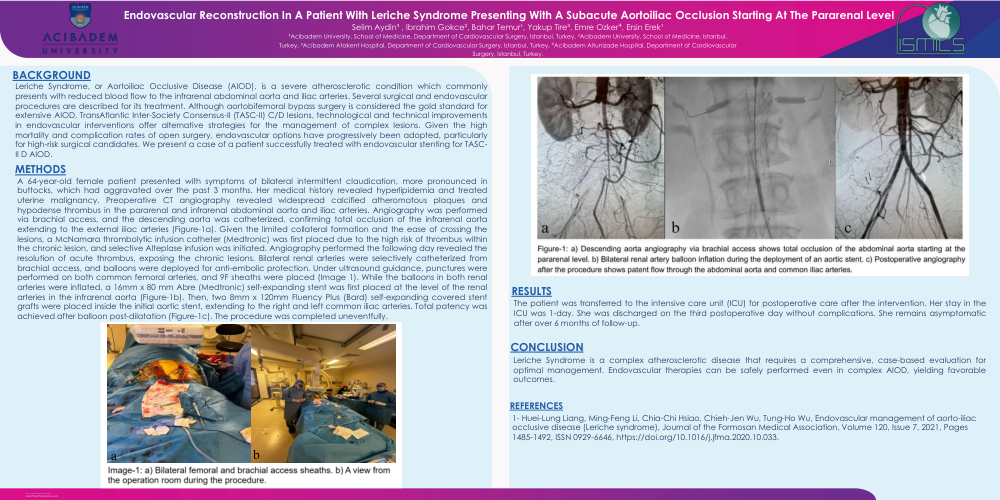
A 64-year-old female patient presented with symptoms of bilateral intermittent claudication, more pronounced in buttocks, which had aggravated over the past 3 months. Her medical history revealed hyperlipidemia and treated uterine malignancy. Preoperative CT angiography revealed widespread calcified atheromatous plaques and hypodense thrombus in the pararenal and infrarenal abdominal aorta and iliac arteries. Angiography was performed via brachial access, and the descending aorta was catheterized, confirming total occlusion of the infrarenal aorta extending to the external iliac arteries (Figure-1a). Given the limited collateral formation and the ease of crossing the lesions, a McNamara thrombolytic infusion catheter (Medtronic) was first placed due to the high risk of thrombus within the chronic lesion, and selective Alteplase infusion was initiated. Angiography performed the following day revealed the resolution of acute thrombus, exposing the chronic lesions. Bilateral renal arteries were selectively catheterized from brachial access, and balloons were deployed for anti-embolic protection. Under ultrasound guidance, punctures were performed on both common femoral arteries, and 9F sheaths were placed (Image 1). While the balloons in both renal arteries were inflated, a 16mm x 80 mm Abre (Medtronic) self-expanding stent was first placed at the level of the renal arteries in the infrarenal aorta (Figure-1b). Then, two 8mm x 120mm Fluency Plus (Bard) self-expanding covered stent grafts were placed inside the initial aortic stent, extending to the right and left common iliac arteries. Total patency was achieved after balloon post-dilatation (Figure-1c). The procedure was completed uneventfully.
RESULTS
The patient was transferred to the intensive care unit (ICU) for postoperative care after the intervention. Her stay in the ICU was 1-day. She was discharged on the third postoperative day without complications. She remains asymptomatic after over 6 months of follow-up.
CONCLUSION
Leriche Syndrome is a complex atherosclerotic disease that requires a comprehensive, case-based evaluation for optimal management. Endovascular therapies can be safely performed even in complex AIOD, yielding favorable outcomes.
REFERENCES
1- Huei-Lung Liang, Ming-Feng Li, Chia-Chi Hsiao, Chieh-Jen Wu, Tung-Ho Wu, Endovascular management of aorto-iliac occlusive disease (Leriche syndrome), Journal of the Formosan Medical Association, Volume 120, Issue 7, 2021, Pages 1485-1492, ISSN 0929-6646, https://doi.org/10.1016/j.jfma.2020.10.033.